
Feature

Lifetime achievement award: Zeti Akhtar Aziz
Zeti has played a crucial role in efforts to modernise Malaysia’s financial system, and has worked tirelessly to promote Islamic finance, financial inclusion and South-east Asian integration.

Economics in central banking: John Taylor
The Stanford University professor wins this year's economics award for work in designing a global 'rules of the game', at a time when many central banks are demanding deeper co-operation

Global custodian of the year: Northern Trust
As the custody and asset servicing provider wins new business in an expanding list of territories, clients praised its technological capabilities and regulatory nous

Asset manager of the year: State Street Global Advisors
SSGA has helped official institutions to address a complex policy context at a high intellectual level while continuing to offer technically excellent investment services around the world

Sovereign investor of the year: Future Fund
Australia’s sovereign wealth fund took the restrained decision not to increase its risks to chase returns in 2015. Instead it focussed on improving its operational framework

Foreign exchange dealer of the year: HSBC
HSBC has catered to sovereign client needs across a broad range of currencies including the shift out of euro assets and into the renminbi

Payments provider of the year: Intellect Design Arena
The payments system provider has helped the Reserve Bank of India to implement an overarching infrastructure to facilitate mass financial inclusion being implemented in India

Market infrastructure provider of the year: LCH.Clearnet
LCH.Clearnet is a driving force behind compression of over-the-counter derivatives and a leader in tackling too-big-to-fail concerns linked to central counterparty clearing

Technology provider of the year: BearingPoint
BearingPoint's Abacus/Regulator system is helping central banks cope with the vast volumes of data that come with new regulatory reporting requirements

Banknote and currency services provider of the year: Leonhard Kurz Stiftung & Co
The foil provider has developed cutting edge security features for some of the world's largest central banks in a bid to tackle ever more sophisticated counterfeiting

Transparency award: Bank of Israel
Bank of Israel has improved its already strong communications by holding press events after monetary policy announcements, releasing new financial stability reports and introducing forward guidance
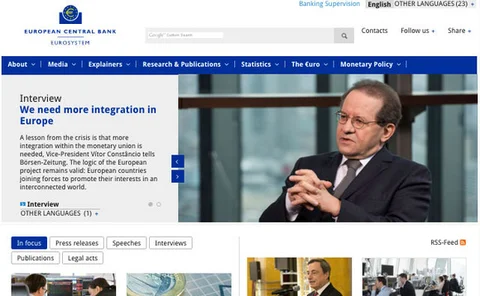
Website of the year: European Central Bank
The European Central Bank built one new website and overhauled another in the year under review – adopting the best practices in responsive design and tailoring both for a mobile audience

The big data revolution and central banking
Central banks are increasingly turning their attention to the challenge of analysing very large datasets. But is ‘big data’ as revolutionary as some claim?

Improving banknote efficiency in India
The RBI manages nearly 80 billion banknotes in circulation – a number set to grow by more than 5% per annum. Vijay Shekhawat explains how the central bank is optimising its banknotes business

Harnessing network theory for more prudent bank supervision
Closer supervisory activities and data-sharing post-crisis offer the potential to harness network techniques to gain an improved understanding of financial risks

Post-conflict central banking
Building the integrity and operational soundness of central banks is a vital priority for post-conflict countries.
The Islamic liquidity facility conundrum
The rapid growth of Islamic finance could undermine both financial stability and monetary policy if central banks do not set up sharia-compliant facilities

Asia’s Basel III woes
New bank capital rules are bridling Association of Southeast Asian Nations banks with regulations tailored to European and American risk profiles, and may be contributing to a slowdown in growth

Cuba: coming in from the cold
The Central Bank of Cuba faces a number of challenges should the country press ahead with economic reform and reintegration in the global financial system

Japan lashed by the Fed
The Abe government is using a questionable reading of history to justify policies that are increasing rather than reducing the gloom over Japan’s prospects

Fed comes under renewed fire as governance structure challenged
An under-staffed board, embarrassing leaks and outspoken regional presidents pose challenges to the Fed as it seeks to exit loose monetary policies. Is it a good time to review its governance structure?

Can inflation derivatives help the ECB hit its inflation target?
The ECB could reinforce its pursuit of price stability by using inflation derivatives should current tools prove insufficient or the implementation of QE encounter technical difficulties

Managing financial stability, monetary systems and the economic order
If policy-makers fail to address the challenges presented by strong feedback loops between the economic and monetary systems, the next crisis could seriously damage faith in market-based economies
The Fed’s impact on emerging market sovereign wealth investors
With central bank reserves seeing their biggest drop in more than a decade during the second quarter of 2015, Arvid Ahlund asks if tighter US policy will make matters better or worse