
Advanced economies

Minority of central banks use GRC platforms
RSA Archer and SAP named as providers
Reputational risk tops central bank concerns
Cyber security and credit/counterparty risk followed

Economics Benchmarks 2021 report – executive summary
Covid-19 coloured central banks’ views on the governance of their economics function in the past year, from research topics to forecasting, data, publications and more
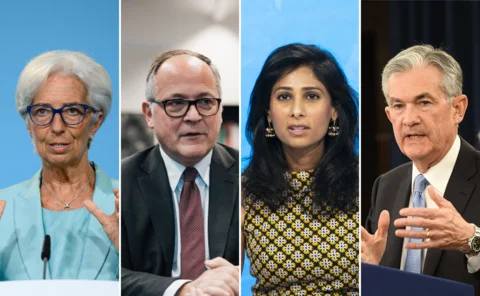
2021: The year in review
The year has seen central banks switch from recovery mode to battling inflation. Central Banking looks back at the stories that made the biggest impact in 2021
Advanced economies draw on wider range of models
DSGE models and newer techniques more common at advanced economy central banks
Quarterly forecast updates predominate
Frequency of forecasts varies more widely in emerging markets
Pandemic spurred use of alternative data
Advanced and emerging market economies prioritise different applications
Unemployment forecast by minority of emerging market economy nations
Data highlights differences based on local economic circumstances
One in five central bank economists have a PhD
Central banks in Africa lag behind peers in sponsoring PhD programmes
Covid-19 causes bigger growth forecast errors
But central banks perform better at forecasting inflation
Policy economists outnumber research economists
Central banks with their own pure research departments tend to employ more policy economists
Economists tend to perform both policy and research duties
Only around a quarter of economics departments have a pure research function

House prices rising at fastest rate since global crisis – BIS stats
Advanced economies see sharpest average increase, but India records largest cumulative rise

ESG reserves adoption challenged by reliance on sovereign bonds
Higher issuance of government-compliant bonds is insufficient to offer investable alternatives to central banks.

Emerging economies more likely to employ access-to-cash policies
Central banks split on access-to-cash policies

Time to stop handing out the pills: the great QE detox
We are facing a serious inflation threat that will test the resolve of central bankers, writes Jagjit Chadha. Central banks must reduce their reliance on QE. But how?
Transactional cash usage ebbs and flows in response to Covid-19
The proportion of payments made in cash ranged from 3% to 88%

Securities lending prevalent in European central banks
Monetary policy, market maturity and currency variation may limit adoption in other regions
National income not only determinant of reserve management staff numbers
Salaries ranged between $11,968–$138,768 among benchmark participants
Emerging nations turned to FX interventions during pandemic
Central banks in emerging nations were twice as likely to implement FX interventions than their peers in advanced economies

IMF: growth prospects dim as pandemic lingers
Fund revises down growth forecasts, warning of inflation, disruption and divergence

Covid-19, crypto and climate weigh on global economy – GFSR
Central banks face difficult “intertemporal trade-offs”; poorer nations unlikely to regain pre-Covid growth levels for “many, many years”, says IMF’s financial counsellor Tobias Adrian

Pandemic is top stability concern for benchmark respondents
House prices, cyber crime and crypto assets are also major worries for central banks
Emerging market central banks regulate more sectors
A higher proportion are the sole banking, non-bank and micro-finance sector regulators