Book notes: The next age of uncertainty, by Stephen Poloz
This book provides a well-informed and well-argued view about our economic future
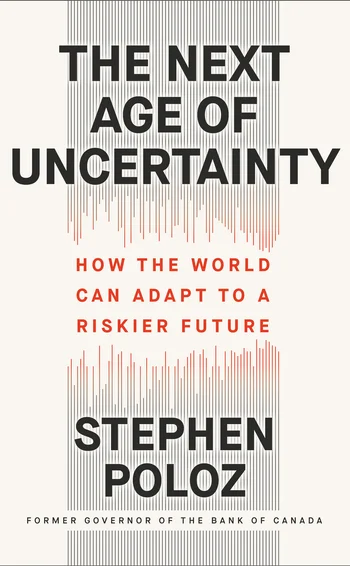
Stephen Poloz, The next age of uncertainty: how the world can adapt to a riskier future, Allen Lane, February 2022, 304 pages
When they are appointed as governors, central bankers typically look to build on their predecessors’ records of price, monetary and economic stability in the expectation that the national economy will benefit from this environment, and that will typically show up in improved growth, distributional outcomes and living standards.
After one or two terms in the job, they leave their well-appointed offices, experienced in how an economy really works. They are experts on the opportunities and weaknesses of monetary policy, the role of banks and the financial system, the real-life constraints of politicians, the obsessions of the media, the usefulness and occasional perversity of financial markets, the lack of interest by the general public until something goes wrong, the interplay of micro- and macro-economic pressures, the complexity of monetary and fiscal policy interactions, the worries about financial fragility, the concerns about prudential stability, the frustrations with other central bank actions, the uses and limitations of economic models and their forecasts, and the importance of economic data. In contrast to when they started, they are now older, wiser and more realistic about the mechanisms of the economy and the reach of policy tools.
After they have left office, a surprising number of former central bank governors have felt the urge to write a book, sharing their experiences and looking to the future. This has resulted in some interesting and important tomes.1 Some of these have been war stories, particularly about the global financial crisis, and, no doubt, more are under way about the Covid experience. Some attempt a more holistic view from their experience.
Stephen Poloz’s new book is in the latter category. Poloz was appointed governor of the Bank of Canada in 2013, following a career in Export Development Canada. In 2021, he completed The next age of uncertainty, which surveys recent economic events and looks to the future in an environment of increasing economic uncertainty. He has positioned his book in the tradition of JK Galbraith’s classic The age of uncertainty, published in 1977. In the 1970s, Galbraith’s big economic uncertainties were the impact of baby boomers on the labour force, the two Opec crises, the resulting structural inflation and the pressures on the international monetary system. This was a very different era from today, and Galbraith was never a strong supporter of monetary policy, but the connection is a useful starting point.
Poloz groups his views on economic uncertainty under five broad headings that he labels ‘tectonic forces’: the aging of population and the impact of demographic changes; new developments in technology and the impact of the ‘Industrial Revolution 4.0’; the causes and effects of rising income inequality; the importance of growing public and private debt; and the effects of climate change.
Much of his book is a basic primer on economic interactions and their relationship with economic uncertainty. His views are conventional and he tries to (as Albert Einstein reputedly said) simplify as much as possible, but no more. He understands these big forces for change are not linear, not continuous and do not have single determinate effects.
The argument is that these five tectonic forces when combined contribute to very volatile economic outcomes, which are increasing in frequency and magnitude. Of course, the central banker who has already experienced the ‘tech wreck’, the Asian financial crisis, the less-developed country debt crises, the global financial crisis, and other such events, may not agree with Poloz’s arguments that future risks are increasing.
In addition, Poloz has only limited faith in the ability of economists to improve their predictions and counteract this growing instability. These five tectonic forces may also offer some positive outcomes: for example, the advantages of increased life expectancy on the workforce, the positive productivity impact of new technologies and the potential for sophisticated financial markets to better provide debt for long-term investment.
Much of his book is a basic primer on economic interactions and their relationship with economic uncertainty
Poloz’s more pessimistic view on rising inequality is in line with the results of researchers such as Thomas Piketty, but we know this is a complex story: whether we measure net or gross income, total or disposable income, income or wealth, individuals or households, and where on the income distribution we focus, all makes a difference.
The book seems targeted at the interested businessperson and the concerned man and woman in the street, rather than the questioning central banker. It provides a convincing explanation for the interplay of economic forces and the complications of uncertainty, leavened by folksy stories from Poloz’s Canadian childhood and work experience. The text is very accessible. There are no graphs or tables (though, occasionally, that might have made for easier argument).
The timing of this book means it misses some important events: as it turned out, 2022 was a particularly volatile year, which makes some of the author’s conclusions premature. He could not foresee the complicated recovery from Covid with high employment and inflation; the increasing economic tensions between China and the US, which have decoupled technologies, threatened international trade and damaged global institutions; the invasion of Ukraine by Russia, which triggered commodity shocks and further upset the trade consensus; the revolution in accessible artificial intelligence systems that is sweeping the IT world; and the occurrence of some extreme weather events, which are increasing our concerns about climate change.
The author sees these uncertainties coming together in what Davos has labelled a ‘poly-crisis’. Having argued that this crisis will grow, he offers some answers. There is a long discussion about the role of monetary policy and fiscal policy, where he argues that policy-makers learned lessons from the global financial crisis and successfully applied them to the Covid pandemic (despite our current fears of over stimulus now resulting in inflation and tight monetary policy with risks of recession). He foresees a growing fiscal burden as governments grapple with uncertainties, and he highlights the need for tax reform to distribute this burden more fairly. If this is done, he argues that automatic stabilisers can be a safer policy response, and he suggests a universal basic income policy could enhance the impact of such a stabiliser.
Despite these possibilities, Poloz predicts there will be more volatility in business cycles, prices, unemployment, interest rates and exchange rates, and that it will therefore be difficult for businesses and households to rationally plan their affairs.
If government policy cannot stabilise this, what is to be done? Poloz suggests improved scenarios for business planning, rethinking hurdle rates for new investment focusing on intangible capital and improving stakeholder capitalism, and better leadership. He notes that his favourite leadership models are Captain Jean-Luc Picard from Star trek and President Jed Bartlet from The west wing (you will need to read the book to discover why).
All in all, The next age of uncertainty is a well-informed and well-argued view about our economic future. The author says during his governorship of the Bank of Canada, the Canadian media labelled him “Sunny Steve”. Reading this book, it is hard to see why.
Notes
1. Mervyn King, Ben Bernanke, Alan Greenspan, Mark Carney, among other governors have all produced important volumes.
Only users who have a paid subscription or are part of a corporate subscription are able to print or copy content.
To access these options, along with all other subscription benefits, please contact info@centralbanking.com or view our subscription options here: www.centralbanking.com/subscriptions
You are currently unable to print this content. Please contact info@centralbanking.com to find out more.
You are currently unable to copy this content. Please contact info@centralbanking.com to find out more.
Copyright Infopro Digital Limited. All rights reserved.
As outlined in our terms and conditions, https://www.infopro-digital.com/terms-and-conditions/subscriptions/ (point 2.4), printing is limited to a single copy.
If you would like to purchase additional rights please email info@centralbanking.com
Copyright Infopro Digital Limited. All rights reserved.
You may share this content using our article tools. As outlined in our terms and conditions, https://www.infopro-digital.com/terms-and-conditions/subscriptions/ (clause 2.4), an Authorised User may only make one copy of the materials for their own personal use. You must also comply with the restrictions in clause 2.5.
If you would like to purchase additional rights please email info@centralbanking.com