
Eurozone
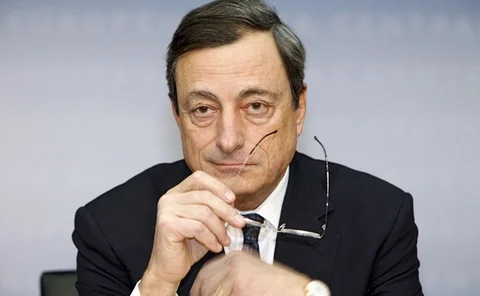
Draghi highlights win-win productivity gains in Berlin speech
While cost adjustments increase competitiveness only relatively, productivity gains, by increasing trend growth, can be absolute and benefit all countries, ECB president tells conference audience

Near-zero interest rates of limited help to non-financial firms
BIS quarterly review article finds that lesser pass-through is partly related to higher premium for risk required by financial intermediaries

Bank of Italy's Visco calls for full-fledged political union
Beyond banking union, the scope of a common eurozone budget - as well as the timeframe for its implementation - must be defined, says governor of Europe's fourth-largest economy

German voters want to keep the euro - but not to save it, poll finds
Two-thirds do not believe the next chancellor has mandate to support eurozone countries financially after the September 22 elections; a third supports break up of eurozone and return to deutschmark

Fall in equities most significant global impact of euro crisis, says ECB paper
Working paper measures impact of euro debt crisis on global financial markets; says the transmission ‘hinges more on trade than on finance’

Opinion: The ECB should not hold back from eurozone bond purchases
There is no danger in the ECB buying large amounts of eurozone government bonds to bolster market confidence – so long as the right conditions are met – says Natixis chief economist Patrick Artus

ECB conflicted by Cyprus bail-in
The ECB’s failure to secure a bail-out for the Cypriot banking system changes the template for sovereign rescue in the eurozone. It also has implications for a central bank that appears conflicted

ECB paper backs broader financing alternatives
Occasional paper says the ECB’s monetary polices has had an ‘uneven effect’ on eurozone businesses; calls for more diverse capital structures

Adopting electronic retail payments boosts real economy, says ECB paper
Working paper says efficient electronic retail payment infrastructure boosts GDP, trade and consumption; integrating and harmonising different markets amplifies these effects

Hungarian paper breaks down components of finanical market indicators
Working paper presents a method for separating the global, regional and country-specific components in market indicators

CEE business cycles still out of sync with eurozone, Polish paper finds
Despite some convergence, differences remain - particularly when it comes to agents' intra- and inter-temporal choices, which account for a large proportion of output fluctuation in the CEE region
ECB paper says monetary transmission ‘far stronger’ in some eurozone countries than others
Interest rate changes have greater impact on bank lending in Germany and Italy than in countries with fewer commercial banks such as Spain and France
Eurozone core ‘regain net influence’ over bond markets, finds Irish paper
Technical paper examines spillovers in the eurozone’s sovereign debt markets; finds the impact of stressed countries on the wider region has diminished
Eurozone countries still react differently to monetary policy, paper finds
Bank of Italy researchers find response has become more homogenous, but differences remain in the reaction of prices and unemployment

Fiscal multiplier tends to double in times of crisis, Bank of Portugal paper shows
The paper analyses the size of short-run fiscal multipliers in both normal and crisis times

Finland economist provides euro crisis ‘view from the north'
Banking union will be key to avoiding a repeat of the eurozone sovereign debt crisis, writes Bank of Finland economist; dealing with the ‘legacy' of weak balance sheets is a ‘key open issue'

Bank of Finland paper attempts to isolate European fiscal multipliers
Research seeks to account for effects of policy co-ordination and business cycles to produce more accurate estimates of European fiscal multipliers

ECB research dissects European competitiveness
Working paper separates competitiveness into political and factor price-driven elements; uses new index to show divergent outcomes across Europe

EBA prepares for impact of single supervisory mechanism
Annual report for 2012 shows the European Banking Authority grew rapidly to meet the demands of a widening stability mandate, which will include working with the eurozone’s SSM

National Bank of Belgium urges care in use of credit conditions surveys
Analysis shows eurozone’s Bank Lending Survey and Belgium’s Survey on Credit Conditions contain useful information – but ‘crucially’ depend on model specification
ECB issues draft regulation on systemically important payment systems
Central bank seeks comment on draft regulations implementing CPSS-Iosco Principles for Financial Market Infrastructures, for systemically important payments systems in the eurozone

Lithuanian governor says banking union does not require treaty change
As Lithuania gears up to take over the EU rotating presidency, central bank governor Vasiliauskas is confident of reaching a compromise on banking union within the existing legal framework

IMF paper says direct eurozone spillovers limited to US and UK banks
Working paper analyses effects of eurozone crisis at bank level; finds direct impact limited to UK and US though other regions could be susceptible to knock-on effects

Latvia to adopt euro in 2014
European Commission gives Latvia the green light to become eighteenth eurozone member after it comfortably meets convergence criteria, but ECB voices concerns over price and financial stability