
Deutsche Bundesbank

Bundesbank warns over surge in German property prices
House prices in the country's biggest cities are up more than a quarter since 2010, as investors search for yield amid record low interest rates; lack of supply also plays a role, says new study

Buba paper: Banks with volatile loan demand load up on wholesale funds
Bundesbank discussion paper argues ‘loan uncertainty' not only result but determinant of wholesale funding, implying regulatory cap on wholesale funding increases exposure to ‘asset-side shocks'
Bundesbank paper presents redesigned DSGE model to tackle unconventional policies
Researchers develop DSGE model using two types of banks, repos and haircuts to yield a better understanding of unconventional monetary policy
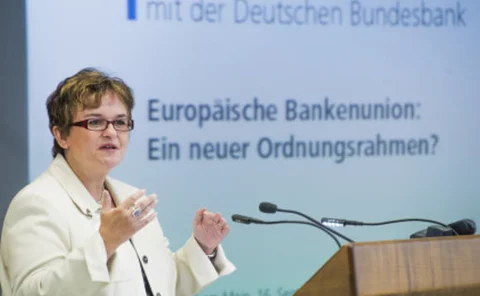
Bundesbank's Lautenschläger welcomes SSM
Sabine Lautenschläger says she is convinced of the advantages of Europe's single supervisory mechanism, but warns the comprehensive balance sheet assessment will pose challenges
Bundesbank economists propose composite FSI with real economy predictive power
Composite financial stress indicator is better at predicting developments in the real eurozone economy than volatility indexes that are currently commonly used

Weidmann slams Europe's stability pact relaxation
Exceptions made for four members of the eurozone earlier this year were inappropriate, Bundesbank president says; making the rules more binding is the only way to stronger monetary union
German voters want to keep the euro - but not to save it, poll finds
Two-thirds do not believe the next chancellor has mandate to support eurozone countries financially after the September 22 elections; a third supports break up of eurozone and return to deutschmark

German banks move to lower-risk sovereign bonds
Deutsche Bundesbank discussion paper investigates banks exposures to sovereign debt and finds they are increasingly investing in bonds from larger countries with lower inflation

Bundesbank’s Dombret urges co-ordination over shadow banking
Executive board member says shadow banking activities are 'not evil' but do produce systemic risks; highlights need to track banks’ exposures to shadow entities and manage ownership links
Buba's Dombret backs EU recovery and resolution plans
Bundesbank board member says new European directive on resolving big banks will be crucial in solving ‘too-big-to-fail', though he has reservations about public participation in the resolution fund

Bundesbank paper says EU convergence is a myth
Researchers identify a split between old and new, western and eastern member states; incomes are converging between smaller groups of countries rather than the EU collective
Bundesbank paper says media exposure shapes inflation expectations
Discussion paper examines how and why inflation expectations differ between the German population; where people go for news is an important factor

Europe could learn from Germany’s macro-prudential approach
Germany’s approach to macro-prudential oversight could offer insights into how to democratise ‘hard’ policy tools and enshrine independence at a time when more power is being transferred to the ECB
German experience offers macro-prudential lessons for Europe, says Buba's Dombret
Germany's approach to macro-prudential oversight could offer insights into how to democratise ‘hard' policy tools and define the role of national central banks, says the Bundesbank's Andreas Dombret
German paper proposes new method for identifying time-invariant regressors
Discussion paper says existing techniques used to identify time-invariant regressors in dynamic panel data models are ‘quite biased’ and proposes a two-stage alternative

Bundesbank paper confirms O-ring theory effect for FDI
Paper written by two economists at the University of Munich finds that the position of a country's industry on the value chain is just as important in determining FDI as is the country's productivity
Bundesbank paper contrasts techniques for identifying monetary policy shocks
Discussion paper compares different methods for identifying monetary policy shocks; looks at use of VAR models and narrative time series
Weidmann says regulation must strengthen principle of individual responsibility
Bundesbank president says higher capital requirements will enable banks to shoulder greater losses by themselves; correct sequence of liability under common European resolution rules also needed

Robert Pringle’s Viewpoint: Rebalancing the fraught relationship between governments and central banks
The growing politicisation of central banking involves central bankers needing to make difficult judgement calls on the areas that lie outside of their competence

Asmussen defends ECB bond purchases at German constitutional court hearing
German representative on the European Central Bank’s executive board Jörg Asmussen rejects charges the central bank exceeded its legal basis by agreeing to purchase the sovereign debt of eurozone nations
Bundesbank research studies how weak resolution rules impact growth
Discussion paper employs ‘catharsis indicator’ to show that stronger resolution regimes reward good firms and help to allocate credit effectively, boosting growth
Weidmann hits out at 'austerity backlash'
Bundesbank president challenges Blanchard study, says no conflict between fiscal consolidation and growth; Banque de France governor Noyer throws weight behind European banking union

Central bank operations push up Target2 turnover
ECB annual report says central banks helped push the value of payments in Target2 system to €634 trillion in 2012; balances diverged as German claims and Spanish liabilities increased
The Eurosystem has done enough; time for politicians to choose
The Eurosystem has done enough to support the eurozone, says Jens Weidmann, who believes the euro area should either accept fiscal union or allow sovereigns to default