
Financial cycle

BIS paper surveys financial shocks in Latin America
Authors study the most effective policy response to financial shocks in different countries

A new era for the BIS
As Basel III inches towards closure and a new BIS general manager prepares to move into his post, Jaime Caruana talks to Daniel Hinge about his eight years at the helm

Xi faces macroeconomic dilemma after China’s party congress
The Chinese premier will have to work hard to avoid a 'Minsky moment', says Hui Feng
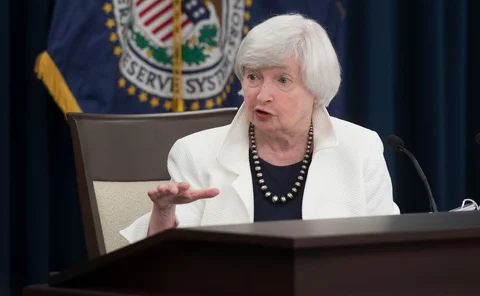
Yellen defends contentious FSOC decision on AIG
Top regulators narrowly vote to remove AIG’s designation as systemic, exposing sharply contradicting views on the Financial Stability Oversight Committee

Caruana urges rethink of global co-operation
Closer co-operation across economic policymaking could help to dampen the backlash against globalisation, BIS chief says

Paper challenges Rey’s ideas on global financial cycle
Cerutti, Claessens and Rose contest idea that capital flows are mainly the result of common shocks or developments in the US
Piecing together a financial theory of stagnation
Ideas presented at recent BIS annual meetings reveal an emerging framework that explains how the financial system may be dragging down the real economy; Hélène Rey was the latest to contribute

BIS urges policymakers to exploit ‘window of opportunity’
Financial cycles are getting close to turning in many economies and central banks and governments must make sure they are prepared, the BIS warns in its 2017 annual report

Obstfeld and Taylor back dual trilemma global finance theory
Economists still need to better incorporate financial stability into their thinking, the authors argue, with the concept of a financial trilemma helping to explain recent instability

US household debt surpasses pre-crisis peak
Household debt exceeds 2008 level for first time, driven in part by auto loans and student debt

Credit cycle matters for fiscal policy – BIS paper
Phase in financial cycle has “substantial” impact on public finances, authors find; commodities cycle less important but matters for some

Credit booms make for more severe recessions – BoE paper
Authors find credit growth is a more reliable predictor of the severity of recessions than debt

Fed authors construct ‘financial stability sentiment’ index
Index derives sentiment from central bank financial stability reports, finding a drop in sentiment tends to precede a “significant deterioration” of financial indicators

Riksbank early warning indicator signals high risks
New measure of financial fragility performs better than credit gap method, economists say; current readings suggest risks are on a par with 2008

BIS economists model benefits of leaning against the wind
Endogenous model of financial crises points to benefits of using monetary policy to lean against financial imbalances, in contrast to many other studies

Kganyago says low point for growth has ‘passed’
The Sarb governor says inflation is “uncomfortably close” to the upper end of the target range; the monetary policy committee unanimously votes to keep rates on hold

Haldane turns to other disciplines to solve big economic questions
BoE chief economist calls for an interdisciplinary approach to tackling the problems economics faces in understanding complex systems; warns of shortcomings in micro-founded models

BoE paper tests agent-based model of macro-prudential policy
Researchers use agent-based model to capture diversity of behaviour between different housing market participants, pointing to risks from larger buy-to-let sector

BIS’s Borio: leaning against the wind must be systematic
Claudio Borio says using monetary policy to stabilise the financial cycle is only likely to be effective if done all the time, not just when trouble is brewing

RBA’s Lowe: credit not enough to measure financial cycle
Deputy governor says the financial cycle’s “considerable intuitive appeal” needs to be backed up with better research on measuring cycles, with balance sheets likely to play a key role

Economists add to theory and empirics of economy’s non-linear dynamics
Paper by Bank of England economists finds “strong evidence” of non-linearity in UK data, while Markus Brunnermeier and Yuliy Sannikov expand theory of financial amplification mechanisms

Climbing ‘Mount Economy’
The BIS’s quest for financial stability-oriented monetary policy throws up questions not only about decision-making but also how one should think about economics, as Claudio Borio explains