Fed’s Brainard calls for major framework overhaul
Yield curve caps, flexible inflation targeting and more active macro-prudential policy could help, governor says
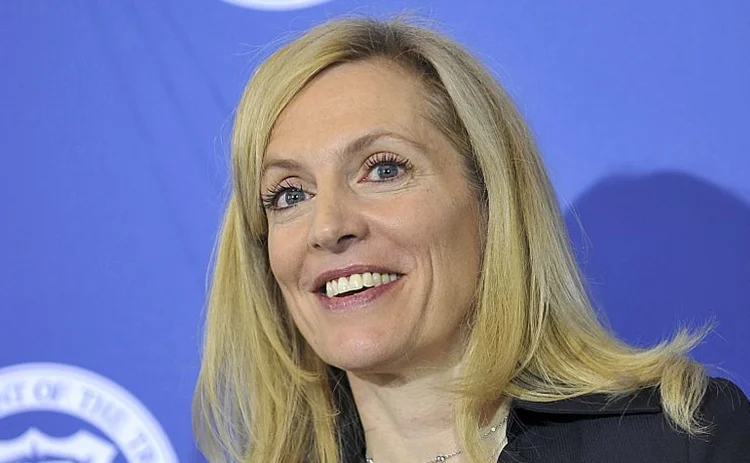
Lael Brainard, a governor of the Federal Reserve, made the case for a significant overhaul of the central bank’s monetary and financial stability policy frameworks in a speech on November 26.
The Fed should consider a suite of changes including a flexible inflation target, more active use of macro-prudential tools and medium-term yield caps, Brainard said.
The new approach would reduce the reliance on large and “lumpy” quantitative easing policies, she said. Furthermore, it could be used alongside the Fed’s short-term rates policy and forward guidance, she explained.
Brainard’s ambitious speech comes as the central bank nears the end of its formal monetary policy framework review, conducted this year. In response to today’s “new normal” macroeconomic environment – lower neutral rates, a flatter Philips curve and sustained low inflation – the Fed has put its strategies, tools and communications under the microscope. Recent minutes show Federal Open Market Committee participants expect that the review could be completed by mid-2020.
While the Fed has not yet decided on any changes to the framework, Brainard’s “preliminary views” suggest at least one policy-maker supports quite significant changes.
“Opportunistic reflation”
In her speech, Brainard first warned about the risk associated with the recent shortfall in US inflation – “which has been true for most of the past seven years,” she said. She noted that “struggles” in Japan and the eurozone “complicate” the more well-known domestic challenges related to low inflation.
“There are important potential spillovers from monetary policy in other major economies to our own economy through exchange rate and yield curve channels,” she said.
Brainard called for rates to hold steady until inflation fully returned to the 2% target. Once inflation has reached the target, the Fed should then allow inflation to overshoot the target for a comparable about of time that it was undershooting, she said. She described this latter process as “opportunistic reflation”.
“Flexible inflation averaging could bring some of the benefits of a formal average inflation targeting rule, but it would be simpler to communicate,” she said.
Brainard hinted that the Fed may have made a timing error when it started to normalise rates in 2015.
“As we saw in the United States at the end of 2015 and again toward the second half of 2016, there tends to be strong pressure to “normalise” or lift off from the ELB pre-emptively based on historical relationships between inflation and employment,” she said. “A better alternative would have been to delay liftoff until we had achieved our targets.”
More active macro-prudential
The evolution of the relationship between inflation and unemployment – most frequently characterised by the Phillips curve – also has implications for financial stability, Brainard warned.
Historically, the Phillips curve was steeper, she argued, meaning that inflation rose more when the economy heated up and slack in the labour market diminished. As a result, the Fed raised interest rates, tightening financial conditions and fending off a build-up of financial vulnerabilities.
“With a flat Phillips curve, inflation does not rise as much as resource utilisation tightens, and interest rates are less likely to rise to restrictive levels,” Brainard said. In combination with lower neutral rates and sustained low inflation, it would be “preferable to use tools other than tightening monetary policy to temper the financial cycle,” she said.
“Active use of macro-prudential tools such as the countercyclical buffer is vital to enable monetary policy to stay focused on achieving maximum employment and average inflation of 2% on a sustained basis,” she said.
Lumpy QE and yield caps
Faced with the prospect of hitting the zero lower bound more frequently in the future, Brainard said unconventional tools should continue to be used in the future. However, she argued that quantitative easing proved to be “lumpy both to initiate at the [effective lower bound] and to calibrate over the course of the recovery”.
“This lumpiness tends to create discontinuities in the provision of accommodation that can be costly,” she said. “To the extent that the public is uncertain about the conditions that might trigger asset purchases and how long the purchases would be sustained, it undercuts the efficacy of the policy.”
Instead, Brainard called for the Fed to explore a yield curve control policy which would place a cap on Treasury yields at the short to medium range of maturity. “Yield curve caps” would reinforce forward guidance by capping yields as far out on the curve as the Fed expects to keep short-term rates at zero, and be more “continuous” than quantitative easing, she said.
Earlier this year, Central Banking spoke with Boston Fed president Eric Rosengren and former vice-chair Donald Kohn, among others, to discuss the feasibility of different approaches to yield curve control and their potential application in the future.
Expressing a similar idea to Kohn, Brainard suggested that perhaps a combination of all of the above policies would work well. For “very severe recessions”, she said, capping both short- and medium-term rates, alongside forward guidance, could also be augmented with asset purchases.
“Presumably, the requisite scale of such purchases – when combined with medium-term yield curve ceilings and forward guidance on the policy rate – would be relatively smaller than if the longer-term asset purchases were used alone,” she said.
Only users who have a paid subscription or are part of a corporate subscription are able to print or copy content.
To access these options, along with all other subscription benefits, please contact info@centralbanking.com or view our subscription options here: www.centralbanking.com/subscriptions
You are currently unable to print this content. Please contact info@centralbanking.com to find out more.
You are currently unable to copy this content. Please contact info@centralbanking.com to find out more.
Copyright Infopro Digital Limited. All rights reserved.
As outlined in our terms and conditions, https://www.infopro-digital.com/terms-and-conditions/subscriptions/ (point 2.4), printing is limited to a single copy.
If you would like to purchase additional rights please email info@centralbanking.com
Copyright Infopro Digital Limited. All rights reserved.
You may share this content using our article tools. As outlined in our terms and conditions, https://www.infopro-digital.com/terms-and-conditions/subscriptions/ (clause 2.4), an Authorised User may only make one copy of the materials for their own personal use. You must also comply with the restrictions in clause 2.5.
If you would like to purchase additional rights please email info@centralbanking.com