Emerging markets resilient amid global shift, governors tell panel

Smaller economies better placed to intervene during crises, say central bank heads
emerging-markets6

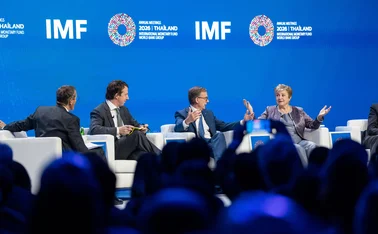
During a panel discussion arranged by the Reinventing Bretton Woods Committee on October 24, central bank governors and academics agreed that structural factors had helped emerging markets to grow resilient. However, the speakers – all of whom were in Washington, DC, for the World Bank and International Monetary Fund (IMF) annual meetings – disagreed about the role multilateral institutions would need to play during a period of transition for the global economy. 

Julio Velarde, governor of the Central Reserve Bank of Peru (BCRP), believed emerging markets had gained credibility in recent decades. Speaking to Central Banking during a break in the discussion, he said emerging economy central banks were now better able to intervene with monetary policy than they had been in the 1990s. He added that Peru had been able to manage its monetary policy independently of the US Federal Reserve.

Velarde was asked whether the similar nature of the recent crises – such as the fallout from Covid and Russia’s invasion of Ukraine – and of the monetary responses to them meant there were new opportunities for co-operation between emerging market central banks. “Conditions are still different,” he replied. “We’re on target since many months ago. We expect to remain at 2% inflation this year and next year. Other countries are not on target, so it’s pretty different just in the region.

“It’s very hard to co-operate. When there has been a big crisis, for example in 2008, the central bank governors of the bigger five economies [in the region] meet. But what could we do? Just cry together.

“We already have a lot of discussions. Most of us meet about every two months. So we know what each other is doing, but we’re not trying to do the same because situations are different.”

Barnabás Virág, deputy governor of the Central Bank of Hungary, told the panel that emerging market economies had been better prepared than during previous crises because of the bold reactions from central bankers. Higher levels of foreign exchange reserves relative to the crises of the previous decades also helped, he said. The small sizes of the central banks’ balance sheets gave them room to manoeuvre during crises through quantitative easing.

Virág said inflation had been particularly painful for central and eastern Europe over the past couple of years. Central bankers there realised the risk of high inflation and started to react during the early stages of the crisis, and they did so faster than their counterparts in advanced economies. He added that emerging market central banks’ communications had been disciplined and proactive.

He described the current decade as one of great transitions, great volatility and perhaps even great crises. The whole global growth model would need to be re-thought because of a shift in what he said had been the four pillars of the world economy.

The first of these pillars was the hyper-globalisation that had taken place from 1990 to 2020, from which emerging markets had benefited as a result of being very open. Anusha Chari, professor of economics at the University of North Carolina, agreed that this was no longer the case, and pointed out that nearshoring, “friendshoring” and other methods of protecting supply chains were now becoming prevalent.

Virág’s second pillar was widely available, cheap labour, which he said was being threatened by the demographic trends that were raising wage costs in many countries.

The third pillar was energy prices, which he said were now three or four times higher than before the pandemic.

The fourth pillar was the price of money. Virág said the US economy had remained strong amid monetary tightening, and that this could prove challenging for emerging markets.

Emerging economies had remained resilient, said Virág, but had to remain ready for new shocks and prepare themselves for tighter fiscal and monetary policy. He argued that convergence of wage levels in emerging and developed economies would lead to increased aggregate demand, which could trigger higher inflation.

Velarde told the panel that markets had not previously distinguished between countries, but that now they were viewing economies separately.

Chari said emerging markets had been tightening policy before developed markets, which was different from what had occurred in the past. Velarde pointed out that the BCRP had started raising and lowering rates before the Fed, and was ahead of the curve in this respect.

However, Chari added that some emerging markets had not managed to meet their inflation targets.

One of the key vulnerabilities, she said, is that more sovereign defaults may be coming as a significant amount of debt was due to mature in 2025 and 2026.

Global systemically important central banks

Piroska Nagy Mohácsi, professor at the London School of Economics, gave a presentation that showed how, since 1980, the global safety net had shifted away from the IMF and towards bilateral swap lines and regional financing arrangements.

“Finally, globally systemic banks behave like such,” she said, referencing how monetary authorities had used the potential for economic harm in other parts of the world impacting their own jurisdictions to justify arranging swaps and repurchase agreements with emerging economy central banks.

However, she said the European Central Bank had taken different approaches for Poland and Hungary: the former had been granted swaps while the latter had received repos, though it was not clear why.

Velarde said the “safety net of the IMF is too small”. Having spoken with many central bankers, he also said the neutral rate was probably a little bit higher than it had been before Covid.

Chari lamented what she called the infrastructure financing gap. The private sector could be incentivised to take informed risks if multilateral institutions played a role in capitalising private investment. She added that a sustainable fiscal path would be key to attracting foreign investment.

Data would also be key to incentivising capital to flow from rich countries to emerging markets, she said. Governors and investors were flying blind, Chari said, as there was not enough data on the rates of return for emerging market infrastructure projects. The World Bank has significant amounts of data, said Chari, and this data could inform risk-taking by private capital and facilitating resource allocation to close the infrastructure financing gap.

US friction

When Velarde spoke to Central Banking on the sidelines of the discussion, he said the US election was casting a large unofficial shadow over the IMF and World Bank meetings.

He said this was so “because of the timing”. However, he added that discussions about the election during the meetings were taking place “in the corridors” rather than officially.

Chari said the election would have serious implications for trade, growth and monetary policy in emerging economies. She added that the biggest concern for many of these countries was across-the-board tariffs, though commodity exporters might be more insulated from the effects.

She said countries could respond by depreciating exchange rates, withholding supplies of critical minerals or divesting from US assets. China might diversify away from the US and get its soybeans from Brazil, its crude oil from Saudi Arabia, and its integrated circuits from Asia.

Only users who have a paid subscription or are part of a corporate subscription are able to print or copy content.

To access these options, along with all other subscription benefits, please contact info@centralbanking.com or view our subscription options here: www.centralbanking.com/subscriptions

You are currently unable to copy this content. Please contact info@centralbanking.com to find out more.

Most read articles loading...

You need to sign in to use this feature. If you don’t have a Central Banking account, please register for a trial.

Sign in
You are currently on corporate access.

To use this feature you will need an individual account. If you have one already please sign in.

Sign in.

Alternatively you can request an individual account

.