Orbán ordered Ukrainian gold and cash seizure – report
Investigation suggests Hungary’s ex-premier sought to use bank assets as bargaining chip for oil
An investigative report has claimed that when the Hungarian authorities seized a Ukrainian bank’s cash transit vehicle in March, the operation was carried out under the personal orders of the then prime minister, Viktor Orbán.
The report, published by Telex on June 3, references sources who it says were either directly or indirectly involved with the authorities’ actions. The seizure caused an international backlash and the National Bank of Ukraine (NBU) told domestic lenders to find alternative routes to transport cash into the war-torn country.
“Orbán was convinced that Ukraine was blocking oil from flowing to Hungary through the Russian-struck Druzhba pipeline for political reasons, not because it was unable to repair the damaged pipeline,” Telex wrote in its report. “A source familiar with the internal affairs of the previous government attributes this as the reason why Orbán pushed for the raid. The prime minister wanted to respond to Kyiv from a position of strength.”
On March 5, the Hungarian Tax and Customs Administration, in co-operation with the country’s counter-terrorism force, abruptly stopped two vans driven by Ukrainian nationals working for Oschadbank. The people in the van were arrested and detained, and the assets – around €35 million ($40.6 million) and $40 million in cash alongside 9kg of gold – were seized on the grounds that they were suspected of being involved in money laundering, the financing of organised crime and funding opposition political groups in Hungary.
Many observers connected the seizure to Ukraine’s unwillingness to repair the Druzhba pipeline, which supplies most of Hungary and its neighbours with oil from Russia. Péter Szijjártó, Hungary’s foreign minister at the time, questioned why banks did not just “wire each other money”, and asked whether the seized assets belonged to what he described as the “Ukrainian war mafia”.
János Lázár, the construction and transport minister, said on March 9 that the funds would stay in Hungary until the pipeline had been reopened and that the government would not be “blackmailed”. “We didn’t do what we did by accident,” he said, without providing supporting evidence that the cash and gold might have been intended for illicit purposes.
The Ukrainians were released and banned from re-entering Hungary after spending 30 hours in handcuffs. During this period, Hungarian officials reportedly spoke to them only in Russian.
Hungary held parliamentary elections on April 12, when Orbán’s party decisively lost. Soon afterwards, the tax administration returned the seized assets. The authority responsible for immigration, visas, residence permits and asylum procedures revoked the expulsion order issued against the Ukrainian couriers, as well as the entry and residence ban.
Today’s report provides further evidence that the seizure was driven by political considerations. Telex wrote that the Hungarian Constitution Protection Office (AH – Hungary’s domestic intelligence service) was acting based on a complaint filed by the Information Office (IH – the external intelligence service).
Under the previous government, both were supervised by Antal Rogán, who headed the prime minister’s cabinet office between 2015 and 2022 and whom the US Treasury in 2025 designated as an individual involved in corruption. “Throughout his tenure as a government official, Rogan has orchestrated Hungary’s system for distributing public contracts and resources to cronies loyal to himself and [Orbán’s] Fidesz political party,” the Treasury wrote at the time.
Bases for suspicion
Telex reported that IH was not concerned with the transportation of money in and of itself, but with the perceived involvement in the transit of Hennadiy Ivanovych Kuznetsov, a former Ukrainian intelligence officer. Kuznetsov’s repeated entry into Hungary had drawn the intelligence services’ attention to the cash shipments.
Hungarian intelligence circles were concerned with Kuznetsov’s ties to Andriy Yermak, the former head of the Ukrainian presidential office and a trusted aide of president Volodymyr Zelenskyy. Yermak is currently facing money laundering charges in Ukraine, and Kuznetsov himself was convicted of corruption in 2011 by a court in Kyiv.
“This was significant in that the authorities later linked the money shipment to money laundering, and the suspicion itself may have arisen largely because of Kuznetsov’s past,” Telex wrote.
Another cause for concern within Hungary’s intelligence services was that funds were not only being transported from Ukraine but were also going in the opposite direction “in no small amounts”. Kyiv explained this by saying the banks were transporting damaged banknotes, but Hungarian intelligence nevertheless found it suspicious that there could be “so many damaged banknotes”.
Authorities could not understand why, given that the logistics were ongoing and involved enormous sums of money, official escorts were requested so rarely
Telex report
A third reason for suspicion was that the transits rarely used police escorts. Although Telex reported that “the Ukrainians had even signed an official contract with the Hungarian police the previous year for armed escort of the convoys”, they only used them three times in 2025 and once this year.
“Hungarian authorities could not understand why, given that the logistics were ongoing and involved enormous sums of money, official escorts were requested so rarely,” Telex found.
A fourth reason for suspicion was a mismatch on the cash transport documentations. Hungarian-language contracts would list Oschadbank as the final recipient, but the English and Ukrainian documents named a Warsaw-based financial institution as the beneficiary, Telex wrote.
Yet Telex also claimed that “some of the above information only became known well after the raid, meaning that at the time of the operation, [the authorities] were working from an even thinner set of facts”.
Timing
Telex highlighted that Orbán had spoken on March 5 at the Hungarian chamber of commerce and industry, where he said the government would “force the Ukrainians to restart oil shipments”. At the time of the speech, the public was still unaware of the seizure.
The outlet said it had contacted AH for comment before publication. Telex was told that in early March, “the decision came from the direction of the state secretariat for the supervision of civilian national security services within the cabinet office of the prime minister, to the effect that ‘the raid on the money transport vehicles must take place on March 5’”.
Telex said multiple independent sources had confirmed to the outlet that the operation had been ordered by Orbán. It added that he was continuously updated on developments throughout the day of the raid.
Orbán’s party, Fidesz, did not immediately respond to Central Banking’s request for comment.
Telex said it was puzzled by the involvement of Hungary’s counter-terrorism force, as the tax authorities had their own tactical unit. Sources told the outlet that the choice to use the counter-terrorism force was made for theatrical purposes, but that there was also a legitimate fear that the Ukrainians would be armed.
The counter-terrorism force told Telex it had exclusive jurisdiction in certain cases to carry out “the apprehension and detention of persons suspected of criminal offences on behalf of requesting authorities”, and that it was the tax authorities that had requested its involvement.
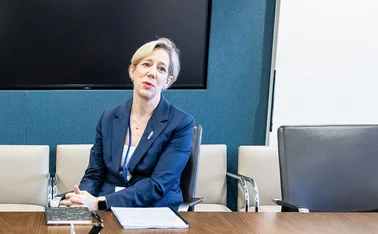
Andriy Pyshnyy, the governor of the National Bank of Ukraine (NBU) tells Central Banking that the “unlawfulness” of the arrest resulted from “the fact that the Hungarian authorities, on their own initiative and prior to the completion of judicial proceedings, revoked the deportation orders and the three-year bans on entry to and [staying] within the Schengen Area that had been imposed on all seven employees of Oschadbank”.
He says that although returning the funds was a welcome gesture, the NBU, alongside Oschadbank and the Ukrainian foreign ministry, would continue to seek “an objective investigation into all circumstances surrounding these events” as well as “appropriate compensation for the physical and moral harm caused to Oschadbank’s property and employees”.
“We have already received support for our public position,” Pyshnyy says. “The president of the European Central Bank, Christine Lagarde, shares our arguments and has emphasised the risks that such a situation poses to the euro as an international currency. This assessment encourages us to continue our efforts to secure a proper evaluation of the incident and the adoption of appropriate response measures in order to prevent similar incidents in the future and to mitigate potential adverse consequences for the financial stability of both Ukraine and the EU as a whole.”
Update, June 5, 2026: This article has been updated to include comments from NBU governor Andriy Pyshnyy
Only users who have a paid subscription or are part of a corporate subscription are able to print or copy content.
To access these options, along with all other subscription benefits, please contact info@centralbanking.com or view our subscription options here: www.centralbanking.com/subscriptions
You are currently unable to print this content. Please contact info@centralbanking.com to find out more.
You are currently unable to copy this content. Please contact info@centralbanking.com to find out more.
Copyright Infopro Digital Limited. All rights reserved.
As outlined in our terms and conditions, https://www.infopro-digital.com/terms-and-conditions/subscriptions/ (point 2.4), printing is limited to a single copy.
If you would like to purchase additional rights please email info@centralbanking.com
Copyright Infopro Digital Limited. All rights reserved.
You may share this content using our article tools. As outlined in our terms and conditions, https://www.infopro-digital.com/terms-and-conditions/subscriptions/ (clause 2.4), an Authorised User may only make one copy of the materials for their own personal use. You must also comply with the restrictions in clause 2.5.
If you would like to purchase additional rights please email info@centralbanking.com