Don’t count on central banks to buy public debt, says Lagarde

ECB president tells Davos panel that divergent global standards may puncture AI bubble
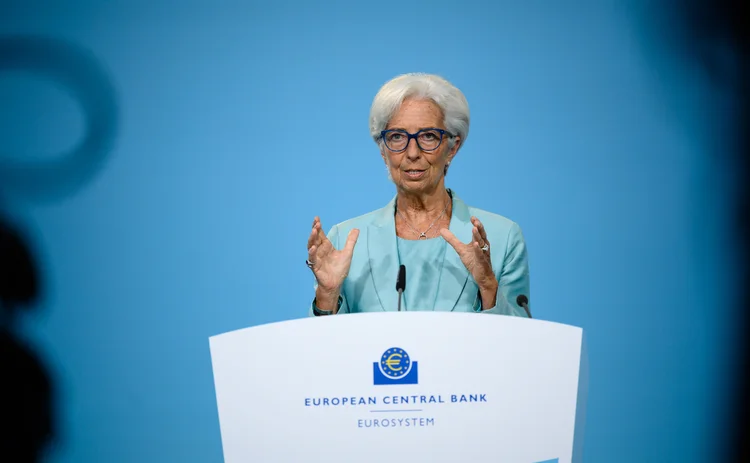
ECB president July 2021

Christine Lagarde has called for fiscal prudence, as “central banks will not always be around” to buy government debt.

Speaking today (January 21) on a panel at the World Economic Forum in Davos, Switzerland, the European Central Bank president distinguished between two kinds of public debt. Debt that was “invested in necessary productive projects”, such as defence, would always find people to finance it , she said. However, those seeking debt for “not productive purposes” would find it “far more difficult” to come by.

“I’m not going to tell you that there is a red line [in the government bond market, beyond which the investor class would not buy any more],” Lagarde said. “And I am not going to tell you that central banks will always be around either. But I think that the nature, or purpose, of which debt is subscribed will matter more than the actual volume.”

When pressed on the topic, she emphasised that central banks would still need to buy bonds during times of crisis. Fiscal authorities would also have to think through the purpose of spending, with a focus on the consequences for ordinary citizens if politicians wanted societies to “stay together”.

She said that in the past, governments had had the responsibility for being fiscally prudent taken away from them, with central banks the only institutions that could try to keep the economy going against an onslaught of reckless spending.

Lagarde arrived late to the panel, which discussed parallels between the 1920s and 2020s. The ECB president was joined by Columbia University professor and economic historian Adam Tooze, BlackRock CEO Larry Fink and Citadel CEO Ken Griffin. The panel was hosted by Andrew Ross Sorkin, the author of Too Big to Fail, whose latest book 1929 recounts the events leading up to the Wall Street crash.

Tooze said Lagarde’s distinction between unproductive and productive spending also had relevance when it came to matters of “political legitimacy and social coherence”. The “social bargain” was “deeply stressed” in both Europe and the US, which was re-awakening the ghosts of fascism. Parties espousing that ideology were “mobilising in Europe on the delegitimisation of public spending”.

Tooze compared today’s situation to the aftermath of World War I, which he described as the “first moment of unipolarity” with the ascendancy of the US and the power of US finance and the dollar. He noted that the coalition of powerful economies back then – comprising the “liberal empire par excellence” of the US, UK and France – had failed at “politics” at the Versailles conference and with the League of Nations. They had sought to use technology and finance to tackle the issues of the day; but without the right political underpinning, the system did not work.

Lagarde followed up by discussing artificial intelligence, as in her view, there were similarities between today’s technological advancements and those of the 1920s.

The gain of productivity that we hope for [from AI] is difficult to reconcile with fragmentation in terms of standards, licensing, access
Christine Lagarde, ECB

She warned that the outlook for AI was “icy” as related technological breakthroughs might only spread within national territories thanks to increased trade protectionism. The collision between geopolitics and AI’s need for data could lead to investments in the sector being “significantly jeopardised” if countries’ differing privacy laws, alongside protectionist barriers, prevented the technology from scaling up.

“The gain of productivity that we hope for [from AI] is difficult to reconcile with fragmentation in terms of standards, licensing, access,” Lagarde added. “I would contend that this can only be remedied by a degree of co-operation.” Whether such co-operation could take place would depend on people’s willingness to accept and tolerate different cultural preferences and views of the world.

BlackRock’s Fink warned that if western economies refused to co-operate and enable AI scaling, then China would “win”, given its large population and “obviously quite different” privacy laws, which would enable it to accumulate far more data. He argued for western powers to spend more in order to compete “properly” against China and allow more time for the technology to be adopted.

Citadel’s Griffin said the actual issue was not reckless spending by tech companies but by governments, which were all, “with little exception”, investing “well beyond their means” in the private sector. The question, in his view, was whether the productivity acceleration that governments hoped to see from AI would overcome the profligate spending they were currently engaged in.

Lagarde responded to both CEOs by reminding them that building the data centres needed for AI’s scaling up would be “capital-intensive, energy-intensive and data-intensive”.

“We have to be mindful of the three,” she said. “In terms of energy intensity, what kind of energy is being used to manage data will matter. What the consequences will be on the people will matter as well.” Lagarde added that the effects of this increased energy use on climate change would also have to be kept in mind, as otherwise there was a risk of a “dislocation of society”.

The ECB president said central bankers would continue to have each other’s backs, as proven by the public letter of support for the Federal Reserve’s Jerome Powell. She said governments and central banks sometimes had to work together, as they had done at the onset of the pandemic. However, at other times, monetary authorities had to “jeopardise the economy” to deliver price stability.

“For me, the great champion and hero of breaking the back of this dependency on central banks was [former Fed chair Paul] Volcker, who took a major risk to jeopardise the economy to make sure that price stability would be delivered,” she added.

Tooze responded by saying the principle of central bank independence was a product of the 1920s and the emergence of modern democracy, which he said was driven by a vast range of political forces. “One of the reasons America [didn’t] have a central bank earlier is that it is a democracy, and capitalist democracies are contentious,” he explained. “And money is contentious in capitalist democracies, and central banks are incredibly contentious.”

Only users who have a paid subscription or are part of a corporate subscription are able to print or copy content.

To access these options, along with all other subscription benefits, please contact info@centralbanking.com or view our subscription options here: www.centralbanking.com/subscriptions

You are currently unable to copy this content. Please contact info@centralbanking.com to find out more.

Most read articles loading...

You need to sign in to use this feature. If you don’t have a Central Banking account, please register for a trial.

Sign in
You are currently on corporate access.

To use this feature you will need an individual account. If you have one already please sign in.

Sign in.

Alternatively you can request an individual account

.