

Stability before competitiveness, say supervisors
ECB’s Donnery and BIS’s Restoy discuss merits of imposing secondary mandate on growth


Supervisory authorities must prioritise financial stability before considering measures to boost competitiveness and growth, top officials at the European Central Bank and the Bank for International Settlements have said.
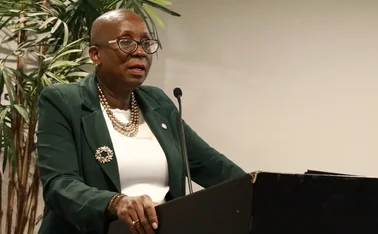
In a panel discussion during the Institute of International Finance’s (IIF) annual meeting on October 15, Sharon Donnery, a member of the ECB’s supervisory board, argued that her team’s contribution to competitiveness came from ensuring the financial system remained safe and sound.
“If you have strong banks – and given the fundamentally important role that banks play in the economy – then they can operate through the ups and downs of the economic cycle,” she told the audience.
When asked about a potential regulatory divergence between the European Union and the US, Donnery said the EU should aim to preserve the high level of banking resilience built since the global financial crisis. However, she acknowledged that there was scope for the EU to make supervision more efficient.
“It’s about trade-offs, and it’s about trying to get that balance really right,” she added.
Donnery’s remarks echoed those of colleagues at the ECB supervisory board, including chair Claudia Buch, who in March warned that debates on competitiveness should not be used as a pretext for watering down regulation.
In a separate session of the IIF event, Neil Esho, secretary-general of the Basel Committee on Banking Supervision, gave a similar warning that financial stability was a prerequisite for growth.
Fernando Restoy, chair of the BIS’s Financial Stability Institute, who appeared alongside Donnery, argued that a competitiveness mandate would not work in the EU due to its unique institutional setup, in which prudential regulations are primarily set by the legislative branch.
“The [EU] supervisory authorities, including the ECB, have no formal rule-making powers,” he said. “This is clearly at odds with what happens with most supervisors around the globe.”
Restoy believed a competitiveness mandate would fare better in countries where the delegation of power to supervisory authorities was stronger. The US Federal Reserve and the Bank of England, for example, could decide whether to implement global standards, whereas the ECB could not, he noted.
“I think the case for introducing secondary mandates for European supervisory authorities is certainly much weaker,” he said.
EU authorities are considering ways to boost the bloc’s competitiveness as they see a widening gap with the US.
According to a Reuters report on Wednesday, Germany’s chancellor, Friedrich Merz, was expected push for deregulation in the EU banking sector, fearing that European banks had become too heavily regulated and had been losing ground to their US counterparts.
Only users who have a paid subscription or are part of a corporate subscription are able to print or copy content.
To access these options, along with all other subscription benefits, please contact info@centralbanking.com or view our subscription options here: www.centralbanking.com/subscriptions
You are currently unable to print this content. Please contact info@centralbanking.com to find out more.
You are currently unable to copy this content. Please contact info@centralbanking.com to find out more.
Copyright Infopro Digital Limited. All rights reserved.
As outlined in our terms and conditions, https://www.infopro-digital.com/terms-and-conditions/subscriptions/ (point 2.4), printing is limited to a single copy.
If you would like to purchase additional rights please email info@centralbanking.com
Copyright Infopro Digital Limited. All rights reserved.
You may share this content using our article tools. As outlined in our terms and conditions, https://www.infopro-digital.com/terms-and-conditions/subscriptions/ (clause 2.4), an Authorised User may only make one copy of the materials for their own personal use. You must also comply with the restrictions in clause 2.5.
If you would like to purchase additional rights please email info@centralbanking.com
More on Financial Stability

Libya’s new central bank governor faces uphill battle
Experts warn Boukhzam is inheriting a politically compromised institution

BIS and Amro publish ‘ready-to-run’ global liquidity stress test
‘Open access, top-down’ framework aims to overcome data and comparability issues

Head of Turkey’s banking watchdog submits resignation
Former CBRT governor says he wishes to avoid further reputational damage to agency over investment scandal
Small nations can offer big lessons – ECCB deputy
Valda Henry tells Virtual Meetings why collaboration and resilience are crucial in today’s volatile world

Canada’s Tiff Macklem on the US trade dispute, AI and framework renewal
BoC’s governor speaks about declining economic resilience, the need for decisions despite policy dilemmas, Canada’s new structural model, lessons from QE, and more

Paraguay’s central bank credibility ‘in crisis’ over Ueno
Experts raise questions over institution’s supervisory actions and its ties to collapsed digital lender

Bhutan’s king decrees new central bank for ‘mindfulness’ city
Gelephu-based institution will be able to invest in digital assets, alongside conventional reserves

Paraguay’s central bank chief to resign after Ueno Bank falters
Resolution proceedings come after lender’s solvency ratio falls below half of regulatory limit