

Governor of the year: Jerome Powell
The Fed chair has shown high levels of integrity and resolve in upholding his public duty in the pursuit of price stability and maximum employment
The head of the world’s most influential central bank has faced a torrid time in the past year. He has had to cope with extreme levels of political pressure, difficult governance decisions, and uncertain economic and financial market conditions. Ultimately, he has faced up to multiple challenges and attacks, including repeated ones from US president Donald Trump, in a calm and dignified manner. And his actions have provided critical reassurance regarding the Fed’s ability to set monetary policy independently of political interference, giving confidence to stakeholders that collectively underpin the global US dollar financial system. “He has demonstrated exceptional leadership, integrity and commitment to both the Federal Reserve’s dual mandate and global financial stability,” says Pablo Hernández de Cos, general manager of Bank for International Settlements.
Straddling administrations
Powell, a registered Republican, was nominated as a Fed governor by Democratic president Barack Obama in 2011 – an early development that highlighted his credentials as a non-partisan, technocratic public servant who cultivated relationships and understanding with members of Congress and peers. In early 2018, he was appointed Fed chair by Republican president Trump, during the incumbent’s first term. Within five months though, Trump started publicly criticising Powell, saying he was “not happy” with the Federal Open Market Committee’s (FOMC) decision to continue raising interest rates to control inflation. Trump’s interference broke a multi-decade tradition, forged in the aftermath of protracted inflation in the 1970s, of the US executive avoiding public comments on central bank policy.
Trump and Powell’s relationship deteriorated further, with Trump aggressively criticising Powell for not lowering interest rates through to January 2021. At one point in August 2019, Trump even implied Powell might be a more of a threat to the US than Chinese president Xi Jinping. “Who is our bigger enemy, Jay Powell or Chairman Xi?”, Trump posted on Twitter (now X), referring to the leader of the US’s main geostrategic rival. But some viewed Trump’s criticism as geared towards diverting any blame for economic issues away from the administration and towards the Fed.
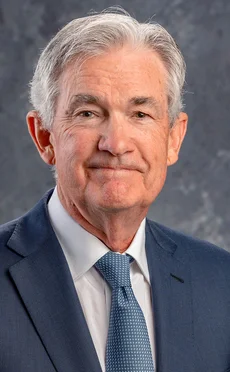
A more traditional Fed chair-US president relationship emerged during the Democrat administration of Joe Biden, with Powell reappointed to lead the US central bank. While, with the benefit of hindsight, the Fed’s reputation for making sound monetary policy was called into question as it navigated the economic fallout from the Covid-19 pandemic – particularly with the FOMC keeping interest rates too low and asset purchases too large for too long during the 2021–23 inflation surge against the backdrop of a large fiscal stimulus – there was never a question of negligence.
Subsequently, as Powell and his colleagues on the FOMC belatedly raised rates and conducted quantitative tightening to bring down inflation, they were credited with engineering a ‘soft landing’ for the US economy, avoiding an economic downturn in 2024 and in the first half of 2025. Former president of the Federal Reserve Bank of Minneapolis Gary Stern notes that the Fed’s policy credibility was a key component in its relative success in bringing down inflation from its post-Covid peak “without even a whiff of recession”.
Renewed attacks on the Fed
Given Trump’s behaviour towards the Fed during his first term, Powell was aware the US central bank and he himself likely would attract the president’s ire should the FOMC take decisions that fulfilled the Fed’s mandate but failed to meet Trump’s objectives. As Trump appeared increasingly likely to be re-elected as president in 2024, bond market investors became nervous. Despite the Fed starting to cut interest rates in September 2024, the 10-year Treasury yield moved in the opposite direction, with spreads widening as investors priced in higher future expected inflation and expanded fiscal deficits under a potential Trump administration.
Former president of the Federal Reserve Bank of Minneapolis Gary Stern notes that the Fed’s policy credibility was a key component in its relative success against inflation from its post-Covid peak ‘without even a whiff of recession’
On November 6, 2024, the day after Trump was elected for a second term, the 10-year yield rose by up to 20 basis points. Powell, however, stressed that Trump’s re-election would have no bearing on the FOMC’s November deliberations, following its first post-inflationary cut of 50bp in September and 25bp in October. He also reaffirmed his position – first communicated in July 2024 and credited as providing confidence to bond investors – that he planned to stay on as Fed chair until his term ended in May 2026. Asked at the November FOMC press conference if he would resign if requested, he replied, “No”. He added that it was his view, and that of the Fed’s, that a president firing or demoting him was “not permitted under the law”.
Powell’s commitments reassured market participants and bond yields narrowed.
On the defensive
Nevertheless, as the transition to Trump’s second presidential term took place at the start of 2025, the US central bank acted in a practical, yet conciliatory, manner, in areas separate to monetary policy. Powell withdrew the Fed from the Network for Greening the Financial System a day before Trump’s inauguration – and ahead of his second withdrawal from the Paris Climate Initiative.
The Fed’s then vice-chair for supervision, Michael Barr, also said on January 6 that he would step down early on February 28 (although he has remained on the board of governors, unlike his predecessor Randal Quarles), clearing the way for Trump to nominate governor Michelle Bowman to take on the top job for banking oversight. Bowman is reported to have plans to cut the Fed’s supervisory and regulatory staff by 30%.
The concessions were in line with previous changes at the Fed when faced with a new administration.
Slipping the noose

In February, Trump signed an executive order asserting “so-called independent regulatory agencies” needed to submit significant actions for review by the White House prior to enactment. The development took place despite many legislators, academic researchers and industry participants holding a view that agencies with narrow, targeted mandates perform their tasks better if they are able to do so free from undue political interference. It also tested the legal precedent established in a 1935 Supreme Court case, Humphrey’s Executor versus the United States, which upheld the ability of Congress to create agencies with independence from the White House. But, with a Supreme Court stacked with Trump appointees and Congress seemingly unwilling to asset its rights, there were concerns that Fed independence might be at an end.
Such a verdict was premature. The order also stated the new rules would “not apply” to the board of governors of the Federal Reserve System or to the FOMC “in its conduct of monetary policy” and that it would apply to the board of governors “only in connection with its conduct and authorities directly related to its supervision and regulation of financial institutions”.
While the provisions carved out protections for the FOMC to set monetary policy decisions, Trump’s attacks on the Fed to lower interest rates continued.
‘Liberation day’ shock
Fed officials soon faced another challenge as Trump unveiled a slew of tariffs on a long list of nations after markets closed on April 2. The stated aim was to use the tariffs to narrow US trade deficits with trading partners. The European Union received a rate of 20% and China 34% – but tit-for-tat responses from China and the US resulted in the Chinese rate soon rising to 145%. Markets reacted sharply, with equities seeing particularly sharp falls. On April 3, the S&P 500 fell by 4.8% and the tech-heavy Nasdaq was down 6%, the biggest single-day falls since the Covid-19 crisis. The dollar weakened around 3% against a basket of currencies, while safe-haven flows pushed US Treasury yields down and the yen up against the dollar.
The situation caused significant uncertainty. Alan Blinder, former vice-chair of the Federal Reserve, told Central Banking at the time that if the tariffs persisted or were raised higher, they would cause stagflation in the US and abroad. “How much inflation and how much lost growth is not predictable now,” he said. “It depends on how bad the trade war becomes and how long it lasts.”
In a speech on April 4, Powell said if the tariffs led to increases in unemployment and inflation, the Fed would need to weigh how far each was from its targets and how long they would take to return there. He added that the Fed would be likely to steer the money supply towards the goal that was furthest from its target, whether that was inflation or full employment. Powell noted that the tariffs were larger than had been anticipated and that the effects on the economy would likely to be greater as well. Powell also feared the inflationary effect could be persistent, with inflationary concerns reflected by firms’ responses to the Fed’s surveys of business sentiment. Near-term expectations rose significantly, with survey respondents citing tariffs as the main reason. Powell also indicated that the public would end up paying for Trump’s tariffs, at least in part. “There isn’t a modern experience of how to think about this,” the Fed chair said.
The full impact of tariffs, which ultimately were implemented at lower levels and with many exemptions, has still to fully play out. But due to the uncertainty, the Fed adopted a cautious approach, with some officials using the analogy of slowing down while driving in fog. Powell argued the Fed was in a good position to wait and see how the economy developed before deciding whether to make a change to monetary policy.
The US president took exception to the Fed’s approach. “The ECB is expected to cut interest rates for the 7th time, and yet, ‘Too Late’ Jerome Powell of the Fed, who is always TOO LATE AND WRONG, yesterday issued a report which was another, and typical, complete ‘mess!’,” wrote the president on April 17. He concluded by stating: “Powell’s termination cannot come fast enough!”
A fait accompli
While talk of Trump seeking to dismiss the Fed chair waxed and waned amid constant discussions about who the executive would nominate as a new chair, Powell needed to focus on his job. This included concluding the Fed’s policy review, the result of which was a pivot away from a failed experiment with ‘flexible average inflation rate targeting’ (fait), which tolerated inflation being higher for longer. Instead, a symmetrical 2% flexible inflation-targeting approach was re-established with the framework promoting maximum employment and stable prices across a broad range of economic conditions. The revised approach no longer results in FOMC members seeking to average out past inflation misses.
Powell unveiled the results during a speech in August 2025 at Jackson Hole. The revised statement followed a public review that included ‘Fed listens’ events at regional reserve banks, participation in a major research conference and policy-maker deliberations at several FOMC meetings.
“Our revised statement emphasises our commitment to act forcefully to ensure that longer-term inflation expectations remain well anchored, to the benefit of both sides of our dual mandate,” said Powell. “It also notes that ‘price stability is essential for a sound and stable economy and supports the well-being of all Americans’.”
The Fed changed its language when it came to not necessarily tightening policy based on uncertain real-time estimates of the natural rate of unemployment. Powell said use of the term ‘shortfalls’ had at times been misunderstood, saying it was “not a commitment to permanently forswear pre-emption or to ignore labour market tightness”: “We removed ‘shortfalls’ from our statement. Instead, the revised document now states more precisely that ‘the Committee recognises that employment may at times run above real-time assessments of maximum employment without necessarily creating risks to price stability’. Of course, pre-emptive action would likely be warranted if tightness in the labour market or other factors pose risks to price stability.”
Our revised statement emphasises our commitment to act forcefully to ensure that longer-term inflation expectations remain well anchored, to the benefit of both sides of our dual mandate
Jerome Powell at Jackson Hole, August 2025
The revised statement notes maximum employment is “the highest level of employment that can be achieved on a sustained basis in a context of price stability”. This focus on “promoting a strong labour market” underscored the principle that “durably achieving maximum employment fosters broad-based economic opportunities and benefits for all Americans”, Powell said, adding that public feedback reinforced the value of a strong labour market for American households, employers and communities.
The Fed also committed to a “balanced approach” when its employment and inflation objectives are not complementary while accounting for the extent of departures from the Fed’s goals as well as the “potentially different time horizons” over which “each is projected to return to a level consistent with the Fed’s dual mandate”. “These principles guide our policy decisions today, as they did over the 2022–24 period, when the departure from our 2% inflation target was the overriding concern,” Powell said.
A new battlefront
Meanwhile, attacks from Trump and some of his allies continued. Powell endured persistent name-calling on social media from Trump, who used terms such as “numbskull”, “a dumb guy”, “nincompoop”, “clown”, “total and complete moron” and “Mr Too Late” in response to the Fed chair’s refusal to guide the FOMC to cut interest rates to 1%.
Former Fed vice-chair, Donald Kohn, tells Central Banking that Powell’s actions stood out for “ignoring the noise” and “refusing to be goaded into an open argument with the president”. “[Powell has] relentlessly focused on bringing nonpartisan technical analysis to bear on promoting progress toward the goals in the dual mandate.”
Some still believed the president’s outspoken comments were designed primarily to deflect any blame for downside from his own economic policies – as occurred during Trump’s first term. But this time was different. The attacks were widened to encompass other members of the FOMC and targeted policy-makers in areas unrelated to monetary policy decision-making.
The primary tactic was to review trading activities, mortgage applications and building project management to seek out any perceived failings by Fed officials. This secured a quick success, when Fed governor Adriana Kugler resigned abruptly on August 1. Kugler did not give a reason for her sudden departure at the time. But an ethics report published in November disclosed she had violated rules prohibiting trading of equities during the blackout period ahead of board meetings. In a financial disclosure form from 2024, she stated that four trades in individual stocks “were carried out by my spouse, without my knowledge, and I affirm that my spouse did not intend to violate any rules”.
Powell endured persistent name-calling on social media from Trump in response to the Fed chair’s refusal to guide the FOMC to cut interest rates to 1%
Kugler’s infraction came after Fed president Robert Kaplan and Boston Fed president Eric Rosengren were forced to resign over trading irregularities during the Covid-19 pandemic. Powell made no effort to block Kugler’s departure after ethics officials refused to certify her disclosures and referred the matter to the Fed’s Inspector General. Her early resignation paved the way for Trump ally Stephen Miran, chair of the Council of Economic Advisers, to join the board on September 16. Miran would become a dissenting member on the FOMC.
Then, Bill Pulte, who Trump had appointed as director of the Federal Housing Finance Agency, launched a broadside at Fed governor Lisa Cook. The housing finance regulator made a ‘criminal referral’, followed up by the Department of Justice, which accused Cook of falsifying documents regarding her primary residence in Michigan and Georgia in 2021. Trump subsequently ordered Cook’s removal from the board of governors, claiming “sufficient reason” for a dismissal.
Trump cited the law governing federal agencies, which sets the rules of Federal Reserve governorship, noting board members can be “removed for cause by the president”. But “cause” is not clearly defined. A preliminary ruling by a district judge Jia Cobb, who said the law appeared to only allow for a Fed governor to be removed “for cause” based on the actions they had taken while in office. Cook joined the board in 2022, after the alleged irregularities.
Cook remained in her position as litigation proceeded into 2026, when conservative justices appeared sympathetic to Cook. Chief justice John Roberts said at a January hearing – that Powell attended – that the administration’s allegations of fraud were contradicted by documentary evidence. Roberts compared claims that Cook had listed two properties as her primary residence on mortgage applications to one small piece of information in a larger stack of papers. Justice Samuel Alito questioned the “hurried” nature of the litigation and expressed concern that no court had reviewed the fraud allegations. Justice Brett Kavanaugh said allowing Cook’s removal could lead to repeated dismissals of Fed governors by future presidents and the administration’s proposed bar for legal removal would be so low that it “would weaken, if not shatter, the independence of the Federal Reserve”.
Powell was criticised by US Treasury secretary Scott Bessent for sitting at Cook’s trial. But Powell himself said: “[The] case is perhaps the most important legal case in the Fed’s 113-year history. And I, as I thought about it, I thought it might be hard to explain why I didn’t attend it.”
Building a case
By this time, Powell had also come under pressure for renovation costs related to the Fed’s Eccles Building and 1951 Constitution Avenue. The bill for these works had risen from an initial estimate of $1.88 billion in 2019 to $2.5 billion by July 2025, in part due to the need to remove hazardous asbestos and lead from the buildings. In June 2025, Powell testified before the Senate Banking Committee, denying reports of extravagant features such as ‘VIP’ elevators or dining rooms were ever in the project scope and others, such as new water features, had been eliminated to save costs. But, on July 10, Office of Management and Budget director Russell Vought accused Powell in a public letter of “grossly mismanaging” the central bank and pursuing an “ostentatious overhaul” while the Fed ran a deficit. In response, Powell requested the Fed’s Inspector General review the project’s costs to address the administration’s allegations.
Public showdown
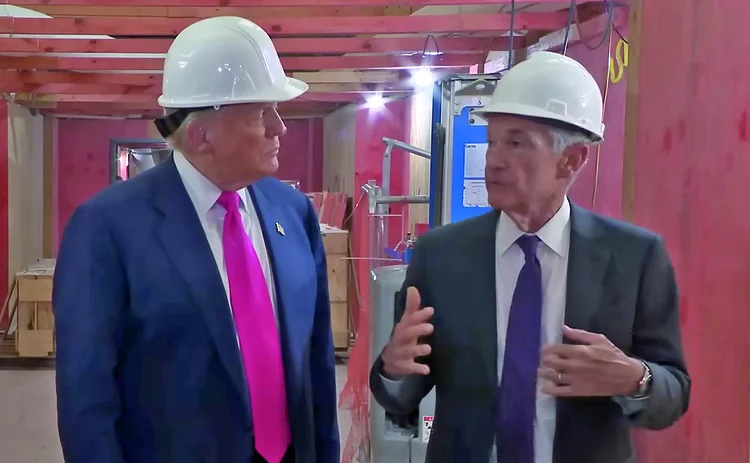
Then on July 24, Trump toured the main Fed construction site with Powell. In front of TV cameras, with the two men in hardhats, Trump claimed the building repair bill was now another $600 million more expensive – for a total cost of $3.1 billion. This caused the Fed chair to shake his head and say, “I haven’t heard that from anybody at the Fed”. Trump then removed a sheet of paper from his pocket and handed it to Powell, in what appeared to be a deliberate act to damage confidence in the Fed chair in front of the cameras. Powell was unfazed. He took a quick look at the note, appraised it and then dismissed the ‘new’ bill as being related to unrelated works on a third building that was completed five years earlier.
The episode showcased Powell’s ability to remain calm and focused under pressure as well as to process new information in a way that enabled him to be able to articulately explain why Trump’s assertions were inaccurate – if the administration’s plan was to make Powell look incompetent, it backfired.
DoJ investigation
By August 2025, Trump had threatened a “major lawsuit” against Powell for a “grossly incompetent job” in managing the building costs. Trump raised the matter again in December when he questioned if “fraud” was involved. Powell remained calm and refused to be goaded.
But matters came to a head on January 9, 2026, when the office of a Trump-appointed District of Columbia attorney general, Jeanine Pirro, served the Federal Reserve with grand jury subpoenas, threatening a criminal indictment related to Powell’s testimony before the Senate Banking Committee in June 2025. The probe followed Trump calling on DoJ officials to be more proactive in launching investigations into his opponents. It made Powell the first chair in Federal Reserve’s history to be made the subject of a ‘criminal investigation’. It also appeared to break a truce agreed between the Republican-majority Congress and the Treasury not to attack Fed independence.
Powell issued a forceful response. He appeared in a video statement on January 11 claiming the DoJ’s ostensible reasons for pursuing the Fed – cost overruns for the refurbishment of two Fed buildings in Washington, DC, and his own testimony to Congress about this – were “pretexts”. “The threat of criminal charges is a consequence of the Federal Reserve setting interest rates based on our best assessment of what will serve the public, rather than following the preferences of the president,” Powell declared.
“When the president’s actions increased the threat to independence to an intolerable degree, [Powell] has called those actions out, thereby rallying support for Fed independence,” says Kohn.
Indeed, the Fed chair received backing via a joint statement from Janet Yellen, Ben Bernanke and Alan Greenspan (all his living predecessors), as well as former Treasury secretaries, including Republican Hank Paulson. They stated that the prosecutorial attacks were instigated “to undermine” Fed “independence”. “This is how monetary policy is made in emerging markets with weak institutions, with highly negative consequences for inflation and the functioning of their economies more broadly. It has no place in the United States whose greatest strength is the rule of law, which is at the foundation of our economic success.”
Powell’s long-standing efforts to work constructively with Congressional leaders during his terms also helped to secure vital political support. “He has shored up support for an independent Fed by keeping open lines of communication with legislators of all parties, making sure they understood the reasons for Fed policy,” says Kohn.
Republican senator Thom Tillis, a member of the Senate Banking Committee, said he would refuse to support any of Trump’s candidates for the Federal Reserve Board of governors, including for the expected replacement of Powell – subsequently named as Kevin Warsh – in May, until the legal issued was “fully resolved”. Another Republican senator, Lisa Murkowski, said the DoJ move was “nothing more than an attempt at coercion”, adding that renovation cost overruns were not “unusual”, as she backed Tillis’s move to block confirmations. Republican senator Kevin Cramer, a critic of Powell, stressed that he did not view the Fed chair as a “criminal” and wanted the matter to be “put to rest quickly”.
When the president’s actions increased the threat to independence to an intolerable degree, [Powell] has called those actions out, thereby rallying support for Fed independence
Donald Kohn
Meanwhile, the heads of 11 central banks – including those of the European Central Bank, Bank of England and Banque de France – alongside the general manager of the Bank for International Settlements, provided Powell with “full solidarity”. In a statement, they said independence was “a cornerstone of price, financial and economic stability in the interest of the citizens that we serve”. They added that Powell has served with “unwavering commitment to the public interest” and was held “in the highest regard by all who have worked with him”.
Pirro stressed that only Powell had referred to a “criminal” investigation. While some pundits believe she had moved against Powell too fast, she appeared to have Trump’s backing when he labelled Powell “either corrupt or incompetent”.
It is unclear how matters ultimately will resolve themselves. The investigation into Powell continues. But even some of those that disagree with the Fed’s policy choices under Powell recognise the importance of central bank independence and the efforts Powell has made to protect independent decision-making at the Federal Reserve.
“Chair Powell has handled the challenges – Kugler, Cook, building expenses – well, all the while keeping the Fed functioning effectively and maintaining the integrity of the policy process,” says former Minneapolis Fed president Stern.
“There has been considerable political pressure to reduce interest rates significantly, pressure that doesn’t appear justified by the ongoing performance of the economy, nor the economic outlook, nor readings on inflation and its prospects,” adds Stern. “Political pressure of the type applied over the past year harkens back to the Volcker years at the Fed, but I don’t recall that it was as personal and ill-considered then.”
Stephen Roach, meanwhile, a former chief economist at Morgan Stanley, described Powell’s actions as a “Volcker-like act of political courage” – referring to the inflation-busting former Fed chair Paul Volcker – and called him a “great American public servant” for maintaining independence despite intense pressure.
Powell’s comments in his extraordinary video address sum up his approach to performing his tasks as a central banker. He stressed how he has always striven to carry out his duties “without political fear or favour”, focused solely on the Fed’s “mandate of price stability and maximum employment”: “Public service sometimes requires standing firm in the face of threats. I will continue to do the job the Senate confirmed me to do, with integrity and a commitment to serving the American people.”
Only users who have a paid subscription or are part of a corporate subscription are able to print or copy content.
To access these options, along with all other subscription benefits, please contact info@centralbanking.com or view our subscription options here: www.centralbanking.com/subscriptions
You are currently unable to print this content. Please contact info@centralbanking.com to find out more.
You are currently unable to copy this content. Please contact info@centralbanking.com to find out more.
Copyright Infopro Digital Limited. All rights reserved.
As outlined in our terms and conditions, https://www.infopro-digital.com/terms-and-conditions/subscriptions/ (point 2.4), printing is limited to a single copy.
If you would like to purchase additional rights please email info@centralbanking.com
Copyright Infopro Digital Limited. All rights reserved.
You may share this content using our article tools. As outlined in our terms and conditions, https://www.infopro-digital.com/terms-and-conditions/subscriptions/ (clause 2.4), an Authorised User may only make one copy of the materials for their own personal use. You must also comply with the restrictions in clause 2.5.
If you would like to purchase additional rights please email info@centralbanking.com
More on Awards

Central Banking Awards 2026 ceremony honours foremost in field
‘Oscars of central banking’ recognise outstanding contributions to the community

Central Banking Awards 2026: the winners in full
Awards recognise extraordinary achievements in another challenging year for central banks
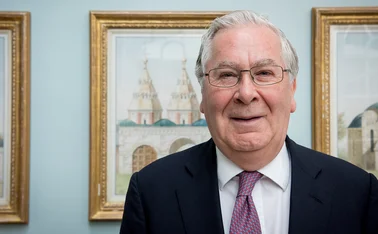
Lifetime achievement award: Mervyn King
The former BoE governor helped restore UK monetary policy credibility, played a central role during the global financial crisis, and has made significant contributions towards better bank oversight and economics
Digital currency initiative: eCurrency
eCurrency translates cultural context into CBDC design, informed by global experience

Currency manager: Central Bank of Curaçao and Sint Maarten
The central bank overcame a nine-year hiatus to launch the Caribbean guilder

Financial market infrastructure – retail: ACI Worldwide
The payments company’s digital central infrastructure has played a key role in Colombia’s Bre-B roll-out as well as elsewhere

Financial services: Citi
The US bank has striven to provide clients with high-level advice as well as service breadth, technical expertise and execution
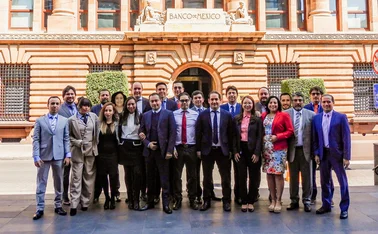
Digital transformation award: Bank of Mexico
Banxico has replaced critical systems with ‘living’, adaptive, decentralised architecture