

Draghi distinguishes ECB forward guidance from Fed and BoE variants
'We don't have precise horizons', ECB president tells former Fed vice chair in Washington
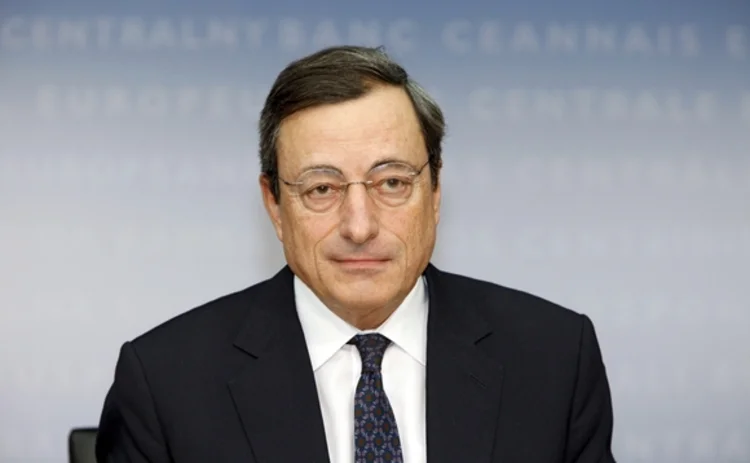
Mario Draghi, the European Central Bank (ECB) president, today distinguished the institution's forward guidance from that of the Federal Reserve and the Bank of England, maintaining it was more "qualitative" but had produced "exactly the same results in terms of expectations".
"We don't have precise horizons," Draghi said of the ECB's guidance during a panel discussion with Fed vice-chair Stanley Fischer in Washington, DC. He said one reason was that it made it "easier to get out at the end".
He noted that markets do not expect the central bank to raise interest rates until 2017 - much later than the Fed, on account of the divergence in monetary policy between the two.
Draghi's remarks were made in response to a question by Donald Kohn, the former Fed vice-chair, during a question and answer session at the Brookings Institution.
In his keynote address, Draghi said the ECB was "transitioning from a monetary policy framework predominantly founded on passive provision of central bank credit to a more active and controlled management" of its balance sheet.
"We expect our measures to have a sizeable impact on our balance sheet, and ultimately, through their impact on all channels of monetary transmission, on inflation," Draghi said.
Following this month's governing council meeting, Draghi said the ECB would increase the size of its balance sheet towards the levels it reached at the beginning of 2012 - which could mean an increase of anything between €500 billion and €1 trillion.
The central bank appears to be willing to go even further. Draghi stressed today the ECB was "ready to alter the size and/or the composition" of its balance sheet "as required".
Draghi also said European leaders were "well advanced" in creating a banking union but added the "design of banking union alone - as ambitious as it is - will not be enough to repair the bank lending channel".
Instead the answer is deeper capital markets, but these "will take time to develop". Therefore the ECB, Draghi said, must "operate in a financial system where - whether we like it or not - banks are dominant".
But he added that as Europe's banking sector is "progressively cleaned up and the deleveraging process reaches its conclusion, banks will have new balance sheet capacity to lend, and our monetary policy will become even more effective".
"I expect credit to pick up soon next year," Draghi said. But he also argued that "without reform, there can be no recovery", adding that he "cannot see any way out of the crisis unless we create more confidence in the future potential of our economies".
"Potential growth is too low to lift our economies out of high unemployment. It is also too low to allow us to overcome quickly the debt burden left over from this crisis and the period that preceded it," Draghi said. "We need to urgently raise that potential. And that means reform".
This theme was explored further in the ECB's monthly bulletin for October, released today, in an article on the impact of the crisis on eurozone labour markets. The article notes that reforms have been "particularly intense in those countries in receipt of international financial assistance" but uneven across the eurozone as a whole.
"While the impact of reforms that have already been undertaken may take some time to produce their full effects, more may be required to achieve the degree of labour market flexibility compatible with membership of a monetary union," the article noted.
"Enhanced efforts to increase inter-regional and inter-country labour mobility across the euro area economies would help tackle high localised unemployment levels, thus reducing the risk that current high levels of unemployment translate into further increases in structural unemployment."
The combination of monetary, fiscal and structural reform "is complex, but it is not complicated," Draghi said today. "The issue now is not diagnosis, it is delivery".
Only users who have a paid subscription or are part of a corporate subscription are able to print or copy content.
To access these options, along with all other subscription benefits, please contact info@centralbanking.com or view our subscription options here: www.centralbanking.com/subscriptions
You are currently unable to print this content. Please contact info@centralbanking.com to find out more.
You are currently unable to copy this content. Please contact info@centralbanking.com to find out more.
Copyright Infopro Digital Limited. All rights reserved.
As outlined in our terms and conditions, https://www.infopro-digital.com/terms-and-conditions/subscriptions/ (point 2.4), printing is limited to a single copy.
If you would like to purchase additional rights please email info@centralbanking.com
Copyright Infopro Digital Limited. All rights reserved.
You may share this content using our article tools. As outlined in our terms and conditions, https://www.infopro-digital.com/terms-and-conditions/subscriptions/ (clause 2.4), an Authorised User may only make one copy of the materials for their own personal use. You must also comply with the restrictions in clause 2.5.
If you would like to purchase additional rights please email info@centralbanking.com
More on Monetary Policy

Lagarde sees slower pass-through after bond sell-off
Higher yields will limit knock-on effects from energy shock, ECB president tells IMF meeting
Warsh: I’ve focused too much on monetary policy
Fed chair vows to pay more attention to supervision, payments systems and consumer affairs

Little evidence of second-round inflation in UK – Bailey
BoE governor says economy more resilient than expected, amid signs of AI investment
Pre-emptive policy has built credibility, says Georgian governor
Enriched monetary policy toolkit assesses whether shocks are transitory in a volatile world

Fiscal consolidation still possible in France – Moulin
BdF governor says Europe facing twin shock from surge in energy costs and bond yields

Singapore surprises with pause in tightening cycle
MAS says decision made against backdrop of rising inflation, but expects price growth to slow next year
BoK to review use of dot plot it debuted this year – Shin
Governor aims to find forward guidance ‘sweet spot’ and says any review will wait until at least next year

Monetary policy must be more agile during AI transition – study
Bank of Italy paper says inflationary developments offer more reliable guide than long-term r*