

This article was paid for by a contributing third party.

Unlocking SDRs: a strategic choice for central banks

Unlocking SDRs can strengthen central bank reserves through strategic investment and balancing long‑term returns against risk, volatility and liquidity needs, writes Alan Cubbon, head of research at Crown Agents Investment Management.

When governments and central banks worldwide received a fresh allocation of special drawing rights (SDRs) in 2021, a number of them considered the potential for investing in this new asset that had arrived on their balance sheets – in conjunction with an attendant new liability. For a central bank holding SDRs, the concern is not simply whether an allocation can be invested, but how to invest it to seek returns above the cost of unlocking it while staying within the institution’s tolerance for risk.
The International Monetary Fund (IMF) created SDRs in 1969 to help developing countries supplement their reserves. An SDR’s value is based on specified nominal amounts of five currencies: the US dollar, euro, sterling, yen and yuan – the last of which was added to the SDR basket in 2016. For a central bank, an allocation can offer a route to additional income from reserves. But turning it into an investment portfolio involves more than seeking a higher yield. It requires a clear view of the cost, the investment horizon and risks.
From allocation to investment
Before a country unlocks its SDRs, its balance sheet carries an SDR asset that earns nothing and a corresponding liability that costs nothing. To invest, the country must convert the SDRs into their component currencies. SDRs cannot be invested directly in capital markets.
Once the allocation is unlocked, the country pays the IMF interest each quarter at the prevailing three-month SDR interest rate. The investment objective is therefore to outperform that rate over time. A strategy that fails to account for this cost may add market exposure without achieving its intended purpose.
Currency management is central to the design. The SDR basket is defined by nominal amounts of each currency – a certain number of dollars, a certain number of euros, and so on – rather than fixed percentage weights. As exchange rates move, the currencies’ weights in the basket change. A portfolio that maintains the corresponding currency amounts and resets its exposures in line with the SDR can keep foreign exchange risk against the SDR at a negligible level. One practical approach is to rebalance monthly, in line with the frequency at which government bond indexes typically reset their constituents. Derivatives are not needed to hedge SDR exposure when the portfolio is weighted appropriately.
That currency alignment should not be confused with the removal of investment risk: it addresses exchange rate exposure against the SDR. Bond prices and returns still respond to changes in interest rates, and longer-maturity strategies have historically experienced greater volatility.
Investing unlocked funds to seek higher returns
As an example of how a central bank chooses to invest its unlocked funds to potentially generate higher returns, it could invest in government bonds of different maturities, where the weights invested in the markets are maintained in line with their weights in the SDR. Shorter-maturity strategies have historically been less volatile, while longer-maturity strategies have delivered greater long-term outperformance against SDR cash, reflecting the cost of borrowing. The choice is a trade-off, not a search for a single strategy that will perform well in every market environment.
Historical analysis of SDR-weighted government bond strategies since the end of 1999 shows that investments extending up to 10 years have, on average, generated more than enough income to cover the cost of borrowing the SDRs from the IMF, as can be seen in figures 1 and 2. Figure 1 shows the returns versus the risks of investing in government bonds of different maturities, where longer-maturity strategies generated incrementally higher returns. Figure 2 presents the total return histories of each strategy.
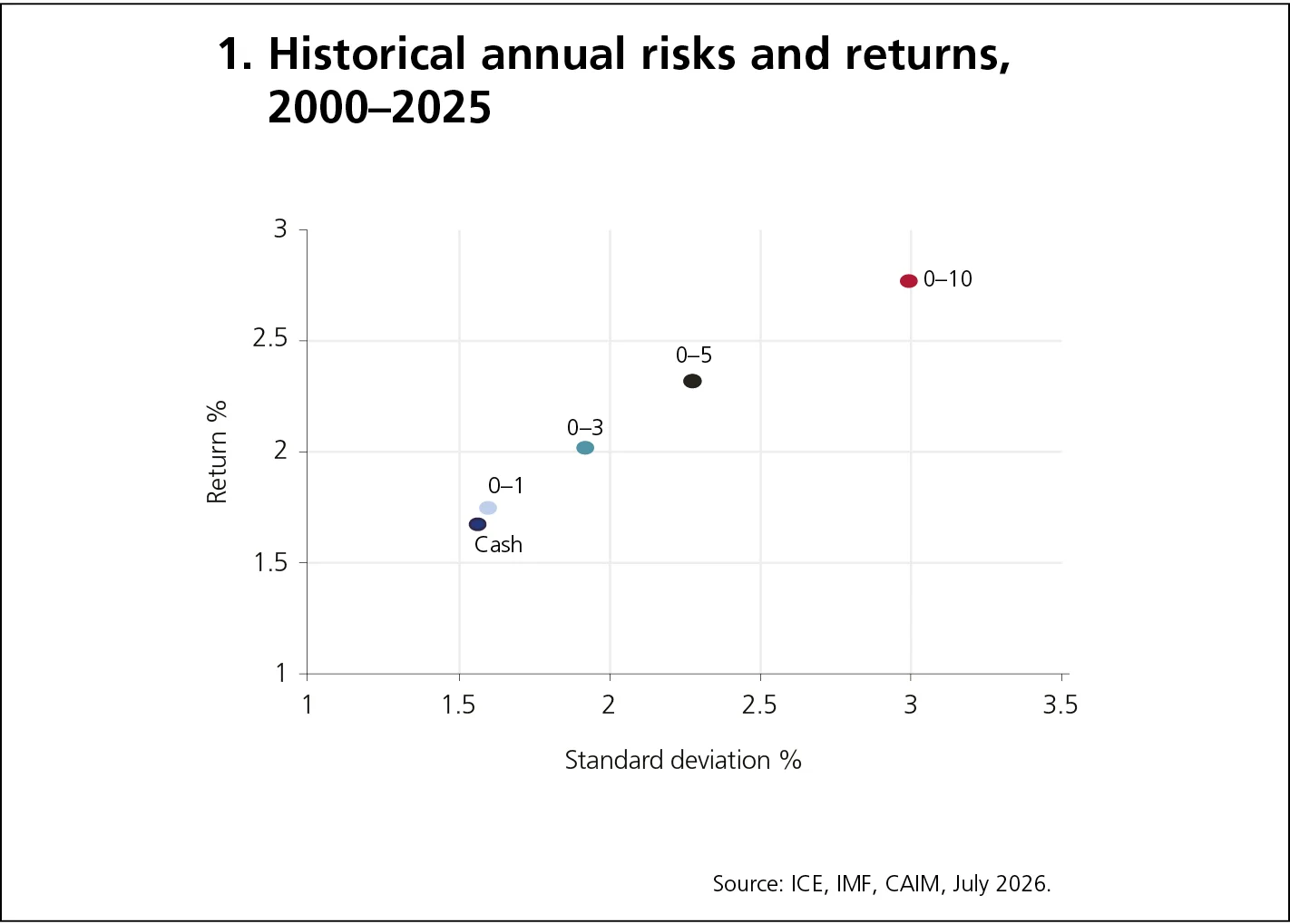
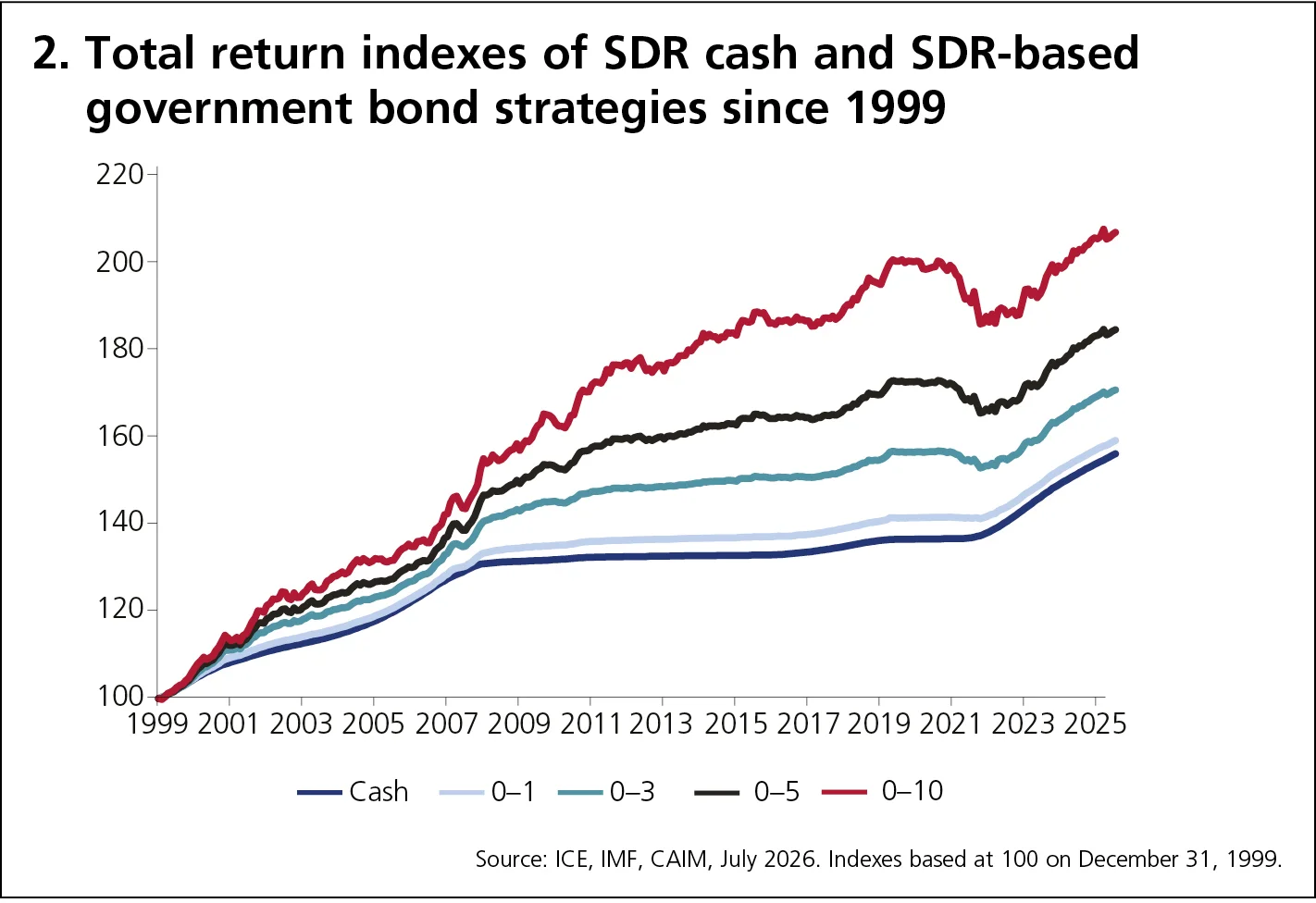
It must be recognised that the return advantage of longer-maturity strategies came with higher volatility. There were periods when cash outperformed bonds, and the clearest example was in 2022, when interest rates rose sharply from very low levels in the wake of the Covid-19 pandemic. With little interest income to cushion the impact of rising yields, longer-duration bonds faced steeper price declines.
Similarly, in 2026, government bond strategies underperformed cash following a sharp rise in yields. Higher starting yields, as at the start of 2026, can provide more income to offset the price impact of further increases, but that is a cushion, not a guarantee of positive returns. Furthermore, yield-curve inversions, while typically short-lived, can also favour cash over duration during those periods.
There is a compelling case to ‘unlock’ SDR assets and earn additional income by investing SDR allocations in the basket’s component markets, and the historical record supports the idea that higher duration, and therefore higher interest rate risk, can provide notably better excess returns over the liability than shorter duration strategies over the long term. But, to reach the long term, one must go through the short term, and therefore an appreciation of the effects of short-term volatility is in order for central banks considering such an SDR-based investment strategy.
A mandate built around risk appetite
The historical record supports considering SDR investment as a long-term reserve management decision, rather than a short-term yield trade. It does not mean that every central bank should choose the same maturity profile. Each institution should select a strategy that fits its own performance objectives and risk appetite, and then use that strategy as the benchmark for an investment mandate.
A passive SDR-weighted government bond portfolio can provide a reference point for that decision. Active management may seek to add returns above the benchmark while remaining within the client’s stated risk preferences. The benchmark makes the objective explicit and provides the central bank with a basis for assessing the additional value and risk taken by active management.
The absence of a repayment date gives countries flexibility over how long they hold their SDR allocations. But this flexibility is not a reason to ignore the cost of unlocking the allocation or the possibility of periods of underperformance. Past performance is no guarantee of future returns.
The investment opportunity afforded by SDRs
Central banks have the opportunity to make their reserves work harder through a carefully designed investment approach. They need to consider their return objective over a particular horizon, the level of short-term volatility the institution can accept and the benchmark that best reflects those choices. Crown Agents Investment Management (CAIM) works with central banks to assess such strategy options, to manage their reserves against agreed benchmarks and to build understanding of SDR logistics and investment.
Learn more
Sponsored content
Copyright Infopro Digital Limited. All rights reserved.
As outlined in our terms and conditions, https://www.infopro-digital.com/terms-and-conditions/subscriptions/ (point 2.4), printing is limited to a single copy.
If you would like to purchase additional rights please email info@centralbanking.com
Copyright Infopro Digital Limited. All rights reserved.
You may share this content using our article tools. As outlined in our terms and conditions, https://www.infopro-digital.com/terms-and-conditions/subscriptions/ (clause 2.4), an Authorised User may only make one copy of the materials for their own personal use. You must also comply with the restrictions in clause 2.5.
If you would like to purchase additional rights please email info@centralbanking.com