

This article was paid for by a contributing third party.

Building future-ready, cross-border instant payment interoperability: strategic architecture choices for central banks

Cross-border instant payments have become a strategic priority for central banks seeking to strengthen financial connectivity, facilitate economic growth and extend the benefits of domestic payment modernisation beyond national borders. Building interoperable, standards-based payment infrastructures requires a long-term architectural vision that balances innovation with governance, operational resilience and regulatory oversight.
Interoperability as the foundation – and its real cost
Interoperability has become a defining architectural principle of modern payment system design, and for good reason. Bilateral connections don’t scale. Each new corridor added to a bilateral model increases integration effort, as every new participant must establish a custom connection to each existing one.
Multilateral, standards-based models seek to reduce this complexity by allowing a domestic payment system to connect once and reach other participating jurisdictions through a common framework.
That efficiency comes with a trade-off central banks should consider explicitly. Participation in a multilateral arrangement requires agreement on shared technical standards, operating rules and governance processes. Depending on the model, certain decisions must be made collectively rather than by one central bank acting independently.
The challenge is therefore to determine where common rules are necessary while preserving national authority over domestic participants, regulatory policy, settlement and oversight.
ISO 20022 provides the global foundation for modern payment messaging, enabling richer transaction data, greater transparency, enhanced straight-through processing and improved consistency across payment infrastructures. However, messaging harmonisation solves the syntax challenge, not the sovereignty challenge. Two jurisdictions may exchange the same standardised message while applying different requirements for screening sanctions, data localisation, consumer protection or dispute resolution.
Central banks should therefore distinguish between two layers of interoperability. Technical standardisation is increasingly mature, although consistent implementation remains a work in progress. Governance and legal alignment require deeper negotiation because they determine how authority, responsibility and risk are shared across jurisdictions.
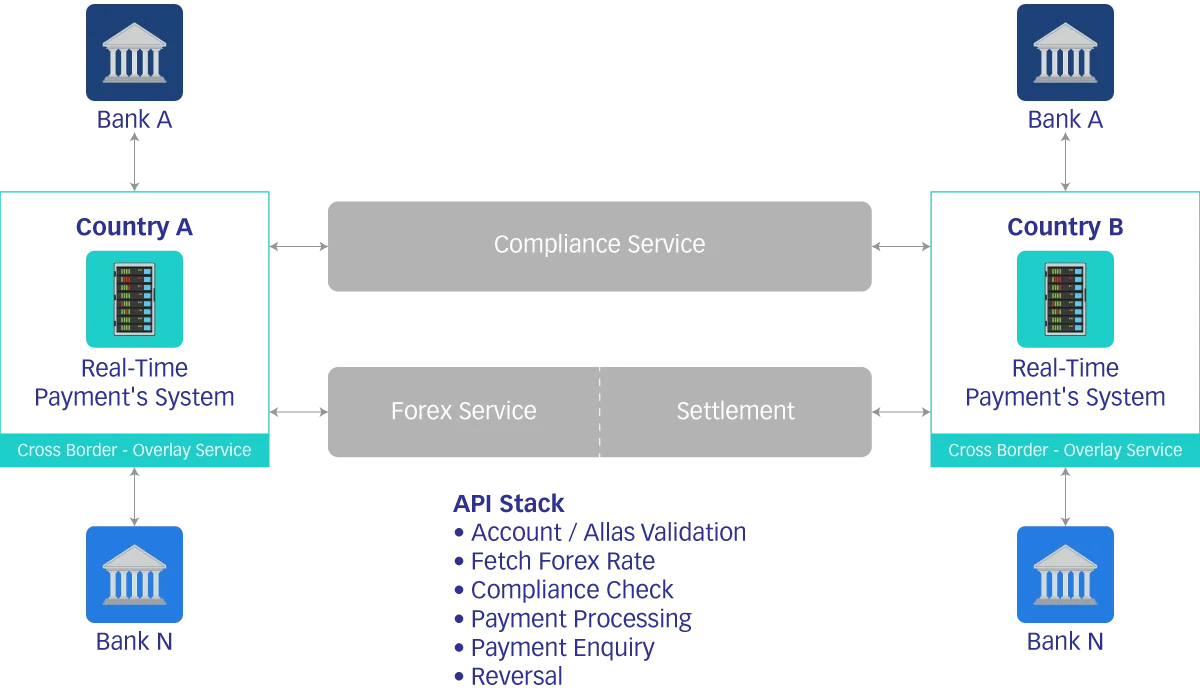
Designing sustainable cross-border payment architectures
While every jurisdiction has its own policy objectives and market characteristics, successful cross-border payment infrastructures share several architectural principles that support long-term sustainability.
Settlement models
Settlement remains one of the most important design considerations for any cross-border payment ecosystem. Whether real-time gross settlement, deferred net settlement, prefunded liquidity or hybrid models, the settlement framework must balance operational efficiency with settlement finality, liquidity optimisation and systemic risk management.
Rather than prescribing a single settlement model, central banks should support configurable settlement arrangements that accommodate the liquidity capacity, market structure and operating requirements of participating jurisdictions. This flexibility allows the network to accommodate institutions and markets of different sizes while maintaining consistent rules and settlement certainty.
Foreign exchange management
Cross-border transactions frequently involve multiple currencies, introducing additional complexity into payment processing. Effective FX management requires transparent pricing, reliable liquidity arrangements, efficient execution mechanisms and seamless integration with payment orchestration.
Flexible payment infrastructures allow jurisdictions to adopt FX models suited to their market structures while maintaining transaction speed, transparency and operational efficiency.
Compliance and risk management
Operating across multiple regulatory environments requires compliance capabilities to be embedded directly into payment workflows. Anti-money laundering controls, sanctions screening, fraud detection, know-your-customer obligations and reporting requirements should be integrated into payment processing to support consistent policy enforcement without introducing unnecessary operational friction.
Embedding compliance capabilities within payment orchestration strengthens operational efficiency, supports automation and reinforces regulatory confidence across participating infrastructures.
Standards-based interoperability
Open standards remain essential to sustainable payment modernisation. ISO 20022 messaging, application programming interface (API)-driven integration, standardised participant directories and intelligent routing simplify future integrations while enabling payment ecosystems to evolve without disrupting existing infrastructure.
Governance and operational resilience
Technology alone cannot deliver trusted, cross-border payment infrastructures. Sustainable interoperability depends on clearly defined governance frameworks that establish participant responsibilities, operational policies, dispute resolution procedures, service-level expectations and oversight mechanisms.
As critical financial market infrastructures, payment systems must incorporate cyber security, business continuity, disaster recovery and operational resilience as core architectural principles, ensuring secure and reliable delivery of services across increasingly interconnected payment ecosystems.
Scalability for future growth
Payment infrastructures should be designed to accommodate growing transaction volumes, additional participants, evolving regulations and emerging payment services without requiring fundamental architectural redesign.
Modular, service-oriented architecture enables central banks to introduce new capabilities through incremental modernisation rather than wholesale system replacement, protecting existing investments while supporting long-term innovation.
Emerging interoperability initiatives and the shift towards multilateral connectivity
Cross-border payments are increasingly moving beyond traditional bilateral arrangements towards multilateral interoperability models that connect multiple domestic payment systems through common standards and shared governance frameworks. This shift reflects the growing recognition that scalable, international connectivity cannot rely on an expanding network of one-to-one integrations, each introducing additional operational, technical and regulatory complexity.
Among the most significant developments in cross-border instant payments is Nexus, an initiative originally developed by the BIS Innovation Hub that has since progressed from blueprint to implementation. Now managed by Nexus Global Payments, the initiative is moving towards operational deployment, with a technical operator appointed to develop and operate the platform and the first live deployment targeted for 2027.
Rather than replacing existing national infrastructures, Nexus is designed to connect domestic instant payment systems through a common multilateral framework based on standardised ISO 20022 messaging, APIs and shared scheme rules. This enables participating jurisdictions to pursue cross-border interoperability while retaining control over their domestic payment systems.
For central banks, this evolution reinforces a broader architectural priority: payment infrastructures should be designed not only for today’s domestic requirements, but also with the standards, governance and interoperability capabilities required for future regional and international connectivity.
Preparing payment infrastructure for the future
Payment infrastructure modernisation should be viewed as a continuous national strategy rather than a one-time technology programme. As payment ecosystems evolve, infrastructures must accommodate new regulatory requirements, digital currencies, increasing transaction volumes and expanding cross-border connectivity without compromising financial stability or domestic oversight.
Achieving this requires standards-based, modular and extensible architectures that enable incremental modernisation instead of large-scale system replacement. Cloud-native deployment models, API-first integration and configurable orchestration capabilities further enhance scalability, operational flexibility and deployment efficiency.
Above all, long-term success depends on effective governance. While technology enables interoperability, trusted collaboration between central banks, payment system operators, regulators, financial institutions and technology partners ultimately determines the success and sustainability of cross-border payment ecosystems.
Conclusion
Cross-border instant payments are becoming a strategic pillar of modern financial market infrastructure. As regional interoperability initiatives continue to expand, the architectural choices made today will determine how effectively payment systems support financial stability, economic integration and future innovation.
By prioritising open standards, interoperability, strong governance and adaptable architectures, central banks can establish payment infrastructures that meet current policy objectives while remaining resilient in an increasingly connected global financial ecosystem.
With decades of experience delivering payment infrastructure solutions for central banks, national payment systems and financial institutions worldwide, ProgressSoft understands the strategic, operational and regulatory considerations that shape successful payment modernisation. Through interoperable, standards-based, modular and cloud-native payment infrastructures, ProgressSoft helps payment authorities build resilient ecosystems that support seamless domestic and cross-border payment services while remaining adaptable to future regulatory and market developments.
Further reading
BIS Committee on Payments and Market Infrastructures (2023), Linking fast payment systems across borders
BIS Committee on Payments and Market Infrastructures (2026), Enhancing cross-border payments step by step: insights from the 2025 monitoring survey
Bank for International Settlements (2024), Fast payments: design and adoption
Nexus Global Payments (2026), Nexus Global Payments appoints technical operator
World Bank (2023), Open banking and the future of fast payment systems
World Bank, Project FASTT (Frictionless Affordable Safe Timely Transactions) retail fast payments. World Bank fast payments tracker.
Sponsored content
Copyright Infopro Digital Limited. All rights reserved.
As outlined in our terms and conditions, https://www.infopro-digital.com/terms-and-conditions/subscriptions/ (point 2.4), printing is limited to a single copy.
If you would like to purchase additional rights please email info@centralbanking.com
Copyright Infopro Digital Limited. All rights reserved.
You may share this content using our article tools. As outlined in our terms and conditions, https://www.infopro-digital.com/terms-and-conditions/subscriptions/ (clause 2.4), an Authorised User may only make one copy of the materials for their own personal use. You must also comply with the restrictions in clause 2.5.
If you would like to purchase additional rights please email info@centralbanking.com