BoE says negative rates ‘in toolbox’ and forecasts slow recovery
First “proper” forecast since Covid-19 outbreak gives little hope of a V-shaped recovery
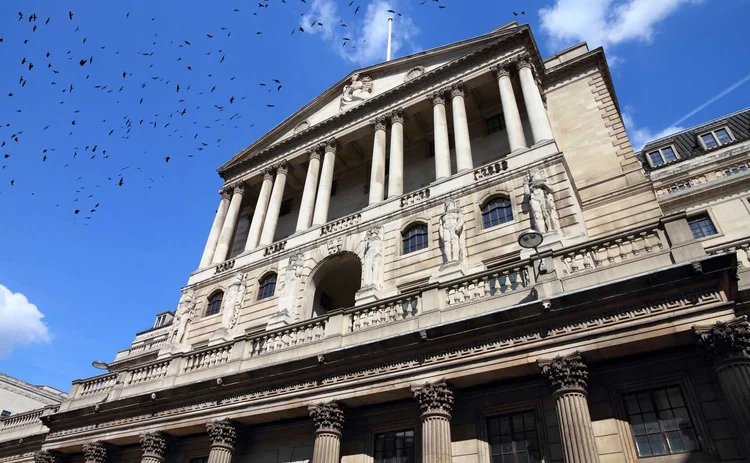
Bank of England governor Andrew Bailey has given his first concrete statement that the central bank is willing to use negative interest rates.
The BoE unveiled its latest monetary policy decision today (August 6), projecting a long and slow recovery for the UK from the Covid-19 shock.
“It is absolutely sensible for us to have them in the toolbox, but we’re not planning to use them at the moment,” Bailey told a press conference as he presented the results of the latest monetary policy and financial stability reports.
The BoE’s monetary policy committee (MPC) voted unanimously to keep rates at 0.1% and the stock of asset purchases at £745 billion ($982 billion).
The path of interest rates implied by market pricing now indicates rates are expected to fall to -0.1% and remain there until the end of the forecast period, the third quarter of 2023.
The BoE views one key consideration for the effectiveness of negative rates to be pass-through by the banking sector. UK banks take a large share of their funding from retail deposits, but rates on such deposits have not typically fallen below zero in countries that have implemented negative policy rates. This can squeeze banks’ net interest margins and could cause them to cut lending
But, the BoE says in analysis published as part of its monetary policy report today, these effects need to be set against the likely benefits to the wider economy, which in turn would likely support bank profits.
Slow recovery
The report includes what deputy governor Ben Broadbent described as the BoE’s first proper forecasts since the outbreak of Covid-19 in the UK. Its previous report, published in May, contained only an “illustrative scenario”, given the very high levels of uncertainty.
Uncertainty has only partially receded, and Bailey said he believed the latest forecasts were the most uncertain in the MPC’s history. Broadbent noted the width of some of the “fan charts” was double the usual amount, reflecting the difficulty of predicting how the virus will progress and how that will impact the economy.
The BoE’s central case envisages UK inflation dropping close to zero in Q4 this year, recovering to the 2% target only in around two years’ time. Meanwhile, it forecasts unemployment will peak at 7.5% in Q4 and take three years to recede to 4%. GDP is expected to contract 5.4% this year before growth rebounds to 8.6% in Q3 of 2021.
Deputy governor Dave Ramsden acknowledged the recovery looked likely to be “drawn out”, in contrast to recent optimism shown by some BoE officials that there would be a V-shaped recovery. In late June, chief economist Andy Haldane described the data as “so far, so V”.
Bailey cautioned that while there were signs of a recovery in some high-frequency indicators, recent experience might not be a good guide to the future.
Scarred economy
Broadbent warned there was likely to be some long-term “scarring” in the labour market, as some jobs may be destroyed permanently, and the skills required for any new jobs that are created may not align with the skills of the current workforce. That could raise the structural unemployment rate.
Bailey noted that the burden of unemployment appeared to be falling on some of the most vulnerable, lowest-paid members of society, particularly those in poorly-paid service jobs that require human contact.
The path of any recovery looks “beguilingly simple” in the central forecast, he said, with a gradual return to normality over the next few years. But he warned there was “huge” uncertainty, with risks generally skewed to the downside.
The BoE is expecting the UK to suffer further strains from the ongoing Brexit process, with the government either striking a trade deal with the EU or leaving on World Trade Organization terms at the end of this year. Either way, the central bank said it expects this to generate “frictions” for UK businesses.
UK investment had already been subdued, which the BoE put down in part to uncertainty around the Brexit negotiations. The latest report notes that while fast indicators of consumption appear to be recovering, investment remains weak. That could weigh on the productive potential of the economy in the years ahead.
The BoE is now exploring ways of supporting investment though equity finance. The financial policy committee says it may be possible to find ways to encourage long-term investors, such as pension funds and insurance firms, to invest in less liquid equities. It says this could help existing firms repair their balance sheets and grow, as well as encouraging new firms to enter the market.
Only users who have a paid subscription or are part of a corporate subscription are able to print or copy content.
To access these options, along with all other subscription benefits, please contact info@centralbanking.com or view our subscription options here: subscriptions.centralbanking.com/subscribe
You are currently unable to print this content. Please contact info@centralbanking.com to find out more.
You are currently unable to copy this content. Please contact info@centralbanking.com to find out more.
Copyright Infopro Digital Limited. All rights reserved.
As outlined in our terms and conditions, https://www.infopro-digital.com/terms-and-conditions/subscriptions/ (point 2.4), printing is limited to a single copy.
If you would like to purchase additional rights please email info@centralbanking.com test test test
Copyright Infopro Digital Limited. All rights reserved.
You may share this content using our article tools. As outlined in our terms and conditions, https://www.infopro-digital.com/terms-and-conditions/subscriptions/ (clause 2.4), an Authorised User may only make one copy of the materials for their own personal use. You must also comply with the restrictions in clause 2.5.
If you would like to purchase additional rights please email info@centralbanking.com test test test