

Lagarde revives pitch for euro’s international role
Single currency can become ‘true source of strength’, ECB president says
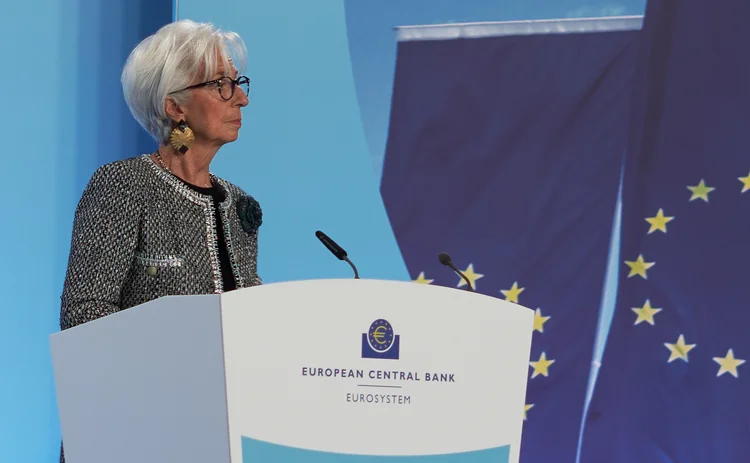
Christine Lagarde has said she would like the eurozone to enjoy the same benefits from its currency as the US does from the dollar.
In a speech in Paris on October 7, the president of the European Central Bank said the euro was “somewhere in between” being a safe-haven currency and a “truly international one”.
Countries whose currencies are safe havens, such as Japan and Switzerland, enjoy capital inflows in times of stress, she said. However, these are not usually signs of “sustained investment”
Only users who have a paid subscription or are part of a corporate subscription are able to print or copy content.
To access these options, along with all other subscription benefits, please contact info@centralbanking.com or view our subscription options here: www.centralbanking.com/subscriptions
You are currently unable to print this content. Please contact info@centralbanking.com to find out more.
You are currently unable to copy this content. Please contact info@centralbanking.com to find out more.
Copyright Infopro Digital Limited. All rights reserved.
As outlined in our terms and conditions, https://www.infopro-digital.com/terms-and-conditions/subscriptions/ (point 2.4), printing is limited to a single copy.
If you would like to purchase additional rights please email info@centralbanking.com
Copyright Infopro Digital Limited. All rights reserved.
You may share this content using our article tools. As outlined in our terms and conditions, https://www.infopro-digital.com/terms-and-conditions/subscriptions/ (clause 2.4), an Authorised User may only make one copy of the materials for their own personal use. You must also comply with the restrictions in clause 2.5.
If you would like to purchase additional rights please email info@centralbanking.com
More on International

Joint US-Japan FX intervention could advance BoJ tightening
Experts say tighter policy needed to lock in yen gains over the long term

ECB to implement new repo facility through five central banks
Monetary authorities in France, Germany, Italy, the Netherlands and Spain to supply liquidity

Battle of Trafalgar holds lessons on global liquidity – CEPR paper
Newly formed BdF struggled to cope with sudden loss of access to dominant currency
Book notes: Redefining the monetary standard in the digital age, by Livio Stracca
A comprehensive and readable account of what digitalisation could mean for monetary policy
Book notes: Can Europe survive? By David Marsh
Marsh poses important questions and cannot be blamed for failing to produce a roadmap to continental salvation

Supply-side shock stuns central banks
The partial closure of the Strait of Hormuz raises fresh challenges for central bank policy-makers

NBU governor calls for EU probe into asset seizure
State-owned bank’s staff now released from custody, but assets remain in Hungary

Europe should be more independent of US – Nagel
Bundesbank president is latest ECB governing council member to call for European CBDC