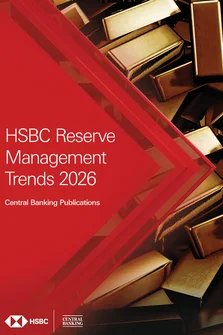
HSBC Reserve Management Trends 2026
First published:
ISBN: 978 1 78272 995 2
As part of your Risk.net subscription you are entitled to 20% off all of your Risk Books purchases. If you would like to place an order please email enquiries@riskbooks.com
Executive summary
Executive summary
Executive summary
Trends in reserve management: 2026 survey results
Digital assets in 2026: key issues in play
Geopolitical shifts and the evolution of reserve management: adapting to a new reality
Reinventing reserve management: governance, risk and agility in a fragmented global financial system
Zafar Parker on 25 years of reserve management at the South African Reserve Bank
Interview: Edna C Villa
Appendix 1: Survey questionnaire
Appendix 2: Survey responses and comments
Appendix 3: Reserve statistics
The full consequences of the economic warfare waged in the Middle East are yet to be revealed. As well as the surge in oil prices, reserve managers face the potential effects of an egregious supply shock. While this year’s HSBC Reserve Management Trends survey began before the US and Israel launched airstrikes on Iran and the Strait of Hormuz was effectively closed, it came after the US sought to annex Greenland, its military operation to capture Venezuelan president Nicolás Maduro, and repeated statements from US president Donald Trump undermining Nato (North Atlantic Treaty Organisation), which was established as a hallmark of peace and security after World War II.
2026 survey findings
Against this backdrop, the first chapter presents the views of 101 reserve managers and found central banks across the world saw geopolitics as the most significant risk they face in 2026. Of 99 central banks that responded to this question, 69 (70%) said geopolitical tensions were their top concern. “Over the next five years, global FX reserves managers will rigorously assess whether the US dollar’s role as the dominant global reserve currency continues, amid rising global fragmentation,” said a reserve manager of a central bank in the Asia-Pacific region. As US policy shakes trust in the greenback, “a more polarised world may see more diversification away from USD, especially if compounded by concerns about Fed independence”, a eurozone official commented.
Digital assets in 2026: key issues in play
Meanwhile, maintaining dollar dominance is a political and fiscal priority for the US. In Chapter 2, HSBC’s Daragh Maher sets out the future of digital assets and the US dollar’s role. “As digital assets become an increasingly significant layer within global finance, the reliance on US dollar rails has shifted from being a niche technical detail to a matter of strategic importance … effectively importing US monetary policy into the blockchain world,” he writes. The dollar’s liquidity in this realm reinforces the “powerful network effects that make the dollar not just dominant, but indispensable in digital finance”. This, Maher argues, makes the US well positioned to fight the rise of rival digital monetary blocs.
Geopolitical shifts and the evolution of reserve management: adapting to a new reality
“The post-Cold War period of relative great power peace appears to be ending, replaced by an era of renewed great power competition,” writes the Central Bank of Brazil’s Ricardo da Costa Martinelli in Chapter 3. Capturing the sentiment of reserve managers among whom geopolitics has surged as a risk, he notes that “what was once primarily a technical exercise centred on balancing safety, liquidity and returns within a relatively stable global order, has evolved into a complex endeavour where geopolitical risk has emerged as a central consideration”. As well as the shifting geopolitical landscape and financial market implications, Martinelli evaluates central bank portfolio implications, structural and operational adaptations, and institutional and analytical capabilities. “Great powers have begun using economic integration as weapons, tariffs as leverage, financial infrastructure as coercion and supply chains as vulnerabilities to be exploited,” he says, arguing that this means “the landscape of international reserve management has undergone a fundamental transformation”.
Reinventing reserve management: governance, risk and agility in a fragmented global financial system
In Chapter 4, Rahmatullah Sjamsudin, proposes that “geopolitics is shaping financial markets more directly”, and outlines how Bank Indonesia has evolved its reserve management to navigate adverse market conditions in which “correlations can flip, and currencies do not always follow rate differentials”. Safety and liquidity “remain non-negotiable, but they are no longer enough on their own”. Reserves also “need to be managed with faster decision cycles, clear guardrails and stronger stress readiness”. If reserves approach minimum levels, the focus shifts towards liquidity readiness and capital preservation, as risk-taking capacity declines. In today’s markets, reserve adequacy “is a guardrail that protects policy space”, writes Sjamsudin.
Zafar Parker on 25 years of reserve management at the South African Reserve Bank
At the South African Reserve Bank, maintaining diversified asset classes and a strong governance framework has been essential during multiple significant financial market crises. Over the last two decades, South Africa’s gross foreign exchange reserves quadrupled from around $20 billion to approximately $80 billion. In Chapter 5, Zafar Parker speaks about his 25 years at the Sarb and the process of continuously refining a comprehensive strategic asset allocation process, while adopting advanced risk and portfolio management technologies. In his view, “despite periodic uncertainty, the depth, liquidity and resilience of US Treasury markets continue to support a significant allocation to US dollar assets”. At the same time, “trade patterns, particularly the currency denomination of imports and external liabilities, play an important role in determining reserve composition”, says Parker: “As trade and financial links among Brics economies deepen, this may gradually be reflected in reserve currency diversification over time.” Reserve management decisions at the Sarb, including currency composition and asset allocation, are not directly based on short-term movements in commodity prices or their impact on the rand, he explains. Instead, the central bank focuses on longer-term structural considerations and external vulnerability metrics.
Interview: Edna C Villa
“Market movements today can be sharp, unpredictable and driven by multiple overlapping factors – such as shifts in monetary policy, geopolitical tensions or sudden changes in inflation expectations,” says the Central Bank of the Philippines’ (BSP) Edna C Villa. This is one of the reasons the central bank introduced daily stress-testing scenarios. In Chapter 6, Villa also speaks about the BSP establishing a New York office – where the largest portion of its reserves are most liquid – to take advantage of market-moving data and news as it happens. She explains that storing part of the central bank’s gold in the UK and France provides market depth and operational readiness “when gold needs to be mobilised quickly”. The resurfacing of inflation, growing fiscal deficits, geostrategic fragmentation, the imposition of unilateral tariffs and attacks on US Federal Reserve independence made it imperative to diversify and manage investments actively. Villa also discusses moving towards a conditional value-at-risk optimisation for the central bank’s three-year investment horizon.
On behalf of Central Banking Publications, I would like to sincerely thank all who contributed to this year’s book, both as authors and survey respondents. As ever, the editors welcome comments and suggestions for future editions. We would like to express our thanks to Bernard Altschuler and his colleagues at HSBC for their continued support of this title.
Joasia E. Popowicz
London, April 2026
Solo los usuarios que tengan una suscripción de pago o formen parte de una suscripción corporativa pueden imprimir o copiar contenido.
Para acceder a estas opciones, junto con todas las demás ventajas de la suscripción, póngase en contacto con info@centralbanking.com o consulte nuestras opciones de suscripción aquí: subscriptions.centralbanking.com/subscribe
Actualmente no puede imprimir este contenido. Póngase en contacto con info@centralbanking.com para obtener más información.
Actualmente no puede copiar este contenido. Póngase en contacto con info@centralbanking.com para obtener más información.
Copyright Infopro Digital Limited. Todos los derechos reservados.
Tal y como se indica en nuestros términos y condiciones, https://www.infopro-digital.com/terms-and-conditions/subscriptions/ (punto 2.4), la impresión está limitada a una sola copia.
Si desea adquirir derechos adicionales, envíe un correo electrónico a info@centralbanking.com prueba prueba prueba
Copyright Infopro Digital Limited. Todos los derechos reservados.
Puede compartir este contenido utilizando nuestras herramientas para artículos. Tal y como se indica en nuestros términos y condiciones, https://www.infopro-digital.com/terms-and-conditions/subscriptions/ (cláusula 2.4), un usuario autorizado solo puede hacer una copia de los materiales para su uso personal. También debe cumplir con las restricciones de la cláusula 2.5.
Si desea adquirir derechos adicionales, envíe un correo electrónico a info@centralbanking.com prueba prueba prueba